Running service
Do restaurant menus have to list allergens? What the rules say in 2026
It depends where you are. The FDA Food Code asks for written allergen notice, and California chains with 20+ locations must list allergens from July 2026.

WaiterPilot Operations
Updated , 8 min read
The short answer
It depends where you are. In the US, where a state or county has adopted the 2022 FDA Food Code, unpackaged food needs written notice of major allergens, not necessarily on the menu. California's SB 68 requires it on the menu or in a digital format for chains with 20 or more locations from 1 July 2026. Not legal advice.
Key points
- The FDA lists nine major food allergens: milk, eggs, fish, crustacean shellfish, tree nuts, peanuts, wheat, soybeans and sesame.
- The 2022 FDA Food Code is a model, not federal law; where it is adopted, unpackaged food needs written allergen notification, by physical or electronic means.
- California's SB 68 covers chains with 20 or more locations from 1 July 2026; its author says a digital version should also come in an alternative format for guests without the technology.
- Most of the work is the same whatever the rule: write each dish's allergens down, keep them current, and have a person answer allergy questions.
- WaiterPilot answers allergy questions only from your menu and asks the guest to confirm with staff; it is not an allergen compliance system.
On this page
It depends on where you are and how big you are. In the US, the FDA’s model Food Code, where a state or county has adopted the 2022 edition, asks for written notice of the major allergens in unpackaged food, but that notice doesn’t have to be printed on the menu itself. California went further: from 1 July 2026, its SB 68 requires allergen notice on the menu or in a digital format for chains with 20 or more locations. In the EU and UK, allergen information is mandatory for food served unpackaged. Whatever applies to you, the work is the same: write every dish’s allergens down, keep them current, and have a person answer the guest. This summary is not legal advice; check your local rules.
Do restaurant menus have to show allergens?
Short answer: in a few places, yes; in most of the US, written allergen notice is required only where the Food Code is adopted, and it need not be on the menu.
The rules we checked, as published on 15 and 16 October 2026:
| Rule | Who it covers | What it asks | Status | Source |
|---|---|---|---|---|
| 2022 FDA Food Code | Food establishments where a state or local authority has adopted it | Written notification of major allergens in unpackaged food, “physical or electronic means, including, but not limited to, brochures”; staff training on the 9 major allergens | A model code, “neither federal law nor federal regulation” | FDA |
| California SB 68 | Chains with 20 or more locations under the same name with substantially the same menu items | Written notice of the nine major allergens for each menu item, on the menu or in a digital format | Chapter 741, Statutes of 2025; from 1 July 2026 | Senator Menjivar’s office, CalMatters digest |
| EU Regulation 1169/2011 | Food businesses, including restaurants and cafés | Allergen information for non-prepacked food; 14 allergens | In force; Member States may set how it is given | European Commission |
| UK (FSA) | Food businesses | Tell consumers if any of the 14 allergens is used; best practice is written information plus a conversation | FSA best-practice guidance, Feb 2025 | Food Standards Agency |
Two words in that table matter. “Adopted”: the Food Code applies only where your state or county has taken it on, and which edition it uses varies. “Written”: in most places, telling a guest out loud is not the whole duty.
What are the nine major food allergens?
Short answer: milk, eggs, fish, crustacean shellfish, tree nuts, peanuts, wheat, soybeans and sesame.
That is the FDA’s list (FDA). Sesame was added by the FASTER Act from 1 January 2023, and the 2022 Food Code added it too. California’s SB 68 uses the same nine and, according to its author, requires them to be listed “using their common name”. The EU and UK list 14, adding items such as celery, mustard, lupin, molluscs and sulphites, so a menu written for US rules is not complete for a guest relying on EU or UK rules.
Why it matters beyond the rule: in a US registry study of 2,827 people with food allergy, dining out was the second most common place for a reaction (21%), and 53.9% of restaurant reactions happened even though the guest had told staff (Oriel et al., 2020). Written information helps the question reach the right person. It doesn’t replace the person.
What does California SB 68 require?
Short answer: chains with 20 or more locations must give written notice of the nine major allergens for each menu item, from 1 July 2026.
California’s official bill site (leginfo) did not open for our checker on 16 October 2026, so we read two other sources: the author’s press release on the California State Senate website, dated 13 October 2025, and the bill status and digest on CalMatters Digital Democracy.
From the author’s release (Office of Senator Caroline Menjivar):
- It applies to “food facilities with 20 locations and more.”
- They must include “written notification of the top nine major food allergens” for each menu item, listed “using their common name.”
- The notice can appear “directly on the food facility’s menu or in a digital format.”
- A digital version “should also be provided in an alternative format for individuals who don’t have access to technology.”
- “The bill goes into effect on July 1, 2026.”
From the digest (CalMatters): it was chaptered on 13 October 2025 as Chapter 741, Statutes of 2025. It covers facilities subject to the federal nutrient-content disclosure rules, meaning chains with “20 or more locations doing business under the same name” offering “substantially the same menu items”. It applies to allergens the facility knows or “reasonably should know are contained as an ingredient in each menu item”. Compact mobile food operations and nonpermanent food facilities are excluded.
What this means in practice: most independent restaurants and small groups are below the 20-location line today. That isn’t a reason to wait. Writing allergens down is good practice everywhere, and it is the same work a future rule would ask for.
Does a QR code menu count as a “digital format”?
Short answer: SB 68 allows a digital format, but we couldn’t read the statute’s exact conditions, so don’t rely on a QR menu alone without advice.
The author’s release says a digital version should also come in an alternative format for guests who don’t have the technology. Even where no rule requires it, that’s sensible. In the National Restaurant Association’s 2024 survey, 59% of full-service diners said they would open a menu by QR code (NRA, 2024), which also means many would not. Keep allergen information on paper, or in a binder staff can bring to the table, alongside anything on a phone.
What information must be included on a menu?
Short answer: it depends on your location and size, so check with your local health department.
The items that come up most often:
- Prices, and any fee or service charge. Some places set how fees must appear; Florida, for example, requires the amount or percentage and the purpose of a service charge on the menu from 1 July 2026 (see our guide to service charges and fees on the bill).
- Nutrition information for large chains. The federal nutrient-content disclosure rules cover chains with 20 or more locations, the same group SB 68 uses.
- Allergen notice, where a rule like SB 68 or the Food Code applies.
- Consumer advisories your local code may ask for. Your health inspector can tell you which apply.
What should an independent restaurant do even if no rule applies?
Short answer: write the allergens down for every dish now, and decide who answers the guest.
- List every dish, sauce, dressing, garnish and side.
- For each one, note which of the nine allergens it contains. If you serve EU or UK visitors, note all 14.
- Include hidden sources: stocks, marinades, frying oil, bread on the side.
- Write down cross-contact you can’t avoid, such as a shared fryer.
- Put the allergens in the dish descriptions, or in a separate chart staff can hand over.
- Name who answers allergy questions on each shift, and who decides in the kitchen.
- Update the list the day a recipe or supplier changes, and pull the dish until it’s right.
- Train every new hire on the list and the rule.
A worked example: three Casa Olivo dishes
Casa Olivo is a fictional restaurant (an example, not a customer). The dishes and recipes are invented for illustration.
| Dish | Menu line before | Menu line after |
|---|---|---|
| Pesto pasta | “Basil pesto, parmesan” | “Basil and pistachio pesto, parmesan. Contains: tree nuts (pistachio), milk, wheat.” |
| Grilled sea bass | “With herb sauce” | “With herb and yogurt sauce. Contains: fish, milk. Fries are cooked in the same fryer as our breaded calamari (wheat).” |
| Tahini salad | “Seasonal greens” | “Seasonal greens, tahini dressing. Contains: sesame. Ask staff about cross-contact.” |
The “before” lines were not wrong, just incomplete. Each “after” line answers the question a guest would otherwise have to ask a busy server, and a chat that reads the menu can only repeat what the line says.
Where does a chat ordering tool fit?
Short answer: it can help guests ask, in their own language, but it can’t carry your legal duty or make the decision.
When guests order with WaiterPilot, they scan the code on their table and the menu opens in their phone’s browser. Here is what happens with allergy questions:
- Answers come only from your menu. When the menu doesn’t say, the chat tells the guest to ask a staff member.
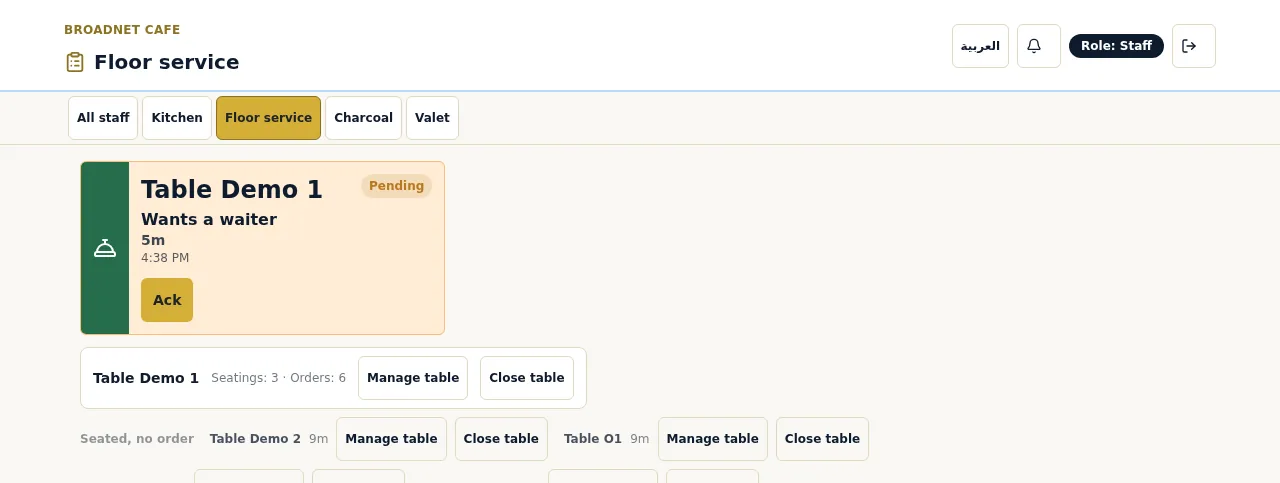
- For allergies, the chat gives what the menu says and asks the guest to confirm with staff. Staff always have the final word. It doesn’t alert staff by itself, so you need a house rule: any allergy mention means a person goes to the table. Guests can call a waiter from their phone, and the call reaches the floor screen within seconds.
- No medical advice. The chat steers medical questions back to the menu, and guests can’t change its rules.
- Notes aren’t translated. A request goes on the ticket as a short note, as the request was taken. Decide who reads notes in other languages.
- Gaps show up in your reports. The owner reports list questions the chat couldn’t answer, which shows you which allergen lines to add.
- Fixing a dish. An owner or manager can mark a dish sold out from a phone until its description is right.
What it is not: an allergen compliance system. It doesn’t check recipes, track cross-contact or replace the written information your rules ask for, and it works alongside your printed menu. If you want an AI that asks about allergies before every order, compare tools on that point. Ordder says its AI Waiter asks about allergies first (as published on 15 October 2026); see our Ordder comparison. Our allergy protocol for QR ordering covers the staff side in detail.
What to do next
Do the eight-step list above this week, whatever your size. Then read your menu as a guest with a nut or sesame allergy would, and fix any dish line that leaves the question open. Our menu preparation checklist shows how to write ingredients and choices for digital ordering, and the allergies and dietary questions page shows exactly what WaiterPilot says to a guest. This summary is not legal advice; check your local rules with your health department or a lawyer.
Questions readers ask
Do restaurant menus have to show allergens?
Not everywhere. In California, chains with 20 or more locations must give written allergen notice on the menu or in a digital format from 1 July 2026. Where the 2022 FDA Food Code is adopted, unpackaged food needs written allergen notice, which can be a brochure or other written form. Check your local rules; this is not legal advice.
What are the 9 major food allergens?
Milk, eggs, fish, crustacean shellfish, tree nuts, peanuts, wheat, soybeans and sesame, as listed by the FDA. Sesame was added from 1 January 2023. The EU and UK use a different list of 14.
Who does California SB 68 apply to?
Food facilities that are part of a chain with 20 or more locations doing business under the same name and offering substantially the same menu items, the same chains covered by federal nutrition-disclosure rules. Compact mobile food operations and nonpermanent food facilities are excluded.
Can allergen information be on a QR code menu instead of the printed menu?
California's SB 68 allows a digital format, and the bill's author says a digital version should also be offered in an alternative format for people without access to technology. We could not read the statute's exact wording on the official site, so ask your lawyer before relying on a QR menu alone.
What information must be included on a restaurant menu?
It depends on your location and size. Common items are prices, any fees with their amount and purpose where rules require it, nutrition information for large chains, and allergen notice where required. Your local health department is the place to check.
Does WaiterPilot keep my restaurant compliant with allergen rules?
No. WaiterPilot answers allergy questions only from your menu and asks the guest to confirm with staff, who have the final say. Keep providing written allergen information the way your rules require.
Sources
- California is the First in the Nation to Require Allergen Disclosures on Restaurant Menus With SB 68, Office of Senator Caroline Menjivar, California State Senate, 2025-10-13 (checked 2026-10-16)
- SB 68: Major food allergens (bill status and digest), CalMatters Digital Democracy, 2025-10-13 (checked 2026-10-16)
- Addition to the 2022 Food Code: Sesame added as a major food allergen, US Food and Drug Administration, 2024-12-10 (checked 2026-10-16)
- Food Allergies, US Food and Drug Administration, 2026-03-11 (checked 2026-10-15)
- Food information to consumers: legislation, European Commission, 2026 (checked 2026-10-15)
- Allergen information for non-prepacked foods: best practice, Food Standards Agency (UK), 2025-02-24 (checked 2026-10-15)
- Characteristics of Food Allergic Reactions in United States Restaurants (J Allergy Clin Immunol Pract), Oriel et al., via FARE, 2020-12 (checked 2026-10-15)
- Restaurant Technology Landscape Report 2024, National Restaurant Association, 2024 (checked 2026-10-15)
- Ordder AI Waiter, Ordder, 2026 (checked 2026-10-15)