Costs and the numbers
Service charges, auto-gratuity and fees on a restaurant bill: how to show them
A service charge, an auto-gratuity and a card fee are not tips. How to name each one, where to show it, and what Florida's July 2026 fee notice rule asks for.

WaiterPilot Research
Updated , 10 min read
The short answer
A service charge, an automatic gratuity and a card surcharge are fees the restaurant sets, not tips; the IRS treats an auto-gratuity as a service charge. Show each fee before the guest orders, with its amount and purpose, and as its own line on the bill. Florida has required that notice since 1 July 2026. Not legal advice.
Key points
- The IRS says a payment is a tip only if the customer decides to pay it and sets the amount; mandatory service charges and auto-gratuities are not tips.
- Florida's amended section 509.214, in force from 1 July 2026, requires the amount or percentage and the purpose of any operations charge on the menu and on the website or app where orders are placed, as applicable.
- Name every fee for what it is, show it before the guest orders, and give it its own line on the bill and the receipt.
- WaiterPilot shows the tax, service charge or gratuity lines you set on the guest's live bill from the first order; it has no guest tip feature and takes no payment.
- Rules differ by state and country. Check your local rules or ask a lawyer before adding a fee.
On this page
A service charge, an automatic gratuity and a card surcharge are all fees the restaurant decides, so none of them is a tip. The IRS treats an automatic gratuity as a service charge. The fair way to handle any fee, and in some places now the required way, is to name it, show its amount and purpose before the guest orders, and give it its own line on the bill. Florida has required a notice like that since 1 July 2026. This guide explains the difference between the charges, what Florida’s rule says, how to word a fee, and a worked bill. It is not legal or tax advice; check your local rules.
What is the difference between a service charge, an auto-gratuity and a tip?
Short answer: the guest decides a tip; the restaurant decides everything else.
The IRS draws the line simply: “A payment is a tip only if the customer voluntarily decides to pay it and determines the amount.” It adds that “extra amounts charged to a bill, such as mandatory service charges, are not tips”, and it calls service charges “also referred to as ‘auto-gratuities’” (IRS, page updated 31 July 2026).
Here is how the common lines compare. Rules from the IRS and Florida are as published on 16 October 2026; the rest is plain description.
| Line on the bill | Who decides it | Can the guest skip it? | How the IRS sees it | Florida’s term (from 1 July 2026) |
|---|---|---|---|---|
| Tip | The guest | Yes | A tip | A “gratuity” or “tip” |
| Service charge | The restaurant | No | A service charge, generally wages if paid to staff | An operations charge |
| Automatic gratuity (for example, parties of 8+) | The restaurant | No | A service charge, not a tip | An operations charge |
| Card surcharge | The restaurant | No | Not a tip | An operations charge |
| Delivery fee | The restaurant | No | Not a tip | An operations charge |
| Sales tax | The government | No | Tax | Excluded (“other than a government-imposed tax”) |
The name on the menu doesn’t change what the charge is. Calling a mandatory 18% a “gratuity” doesn’t make it a tip. That matters for payroll, and it matters to guests, who notice the difference.
Are restaurant service charges legal?
Short answer: in many places, yes, if guests are told clearly before they order. Some places now say exactly how.
Most of the trouble with fees isn’t the fee. It’s the surprise. A guest who sees “Service 18%” for the first time on the bill feels tricked, even if the line is legal. That’s why the newer rules focus on notice: where it must appear, what it must say, and how big the print is.
We can’t summarize every state or country, and the rules change. Below is one rule we read in full on the official site, because it is recent and specific. If you operate elsewhere, use it as a model of what a careful notice looks like, and then check your own rules.
What does Florida’s 2026 restaurant fee rule say?
Short answer: any “operations charge” must be disclosed with its amount or percentage and its purpose, on the menu and where orders are placed, and listed separately on the receipt.
Florida’s SB 606 (Chapter 2025-113, approved by the Governor on 2 June 2025) amended section 509.214 of the Florida Statutes “effective July 1, 2026” (enrolled bill text, bill history, read 16 October 2026). The key points, quoted from the text:
- What counts. An operations charge is “an automatic fee or charge, other than a government-imposed tax, that a customer is required to pay in addition to the cost of the food and beverage purchased.” It “includes, but is not limited to, service charges, automatic gratuities, credit card surcharges, and delivery fees.”
- Where the notice goes. On “the food menu, written contract, and website or mobile application where food and beverage orders are placed, as applicable”, showing “the amount or percentage of the operations charge and the purpose of the operations charge.”
- How big. In a font “equal to or greater than the font used for menu item descriptions.”
- No menus or table service. The notice goes on the menu board or on a clearly readable sign by the register.
- On the bill. The bill must carry a notice that clearly states the percentage or amount of the operations charge.
- On the receipt. “Separate lines for gratuity, an operations charge, and sales tax.”
- Exceptions. It doesn’t apply to a dining plan, package or fixed-price meal whose price is disclosed before purchase, and it “does not create a private cause of action.”
What this could mean for a restaurant that takes orders on guests’ phones:
| Florida requirement | What to check if guests order by QR code |
|---|---|
| Notice on the menu | Your printed menu and the menu guests read on their phone both carry it |
| Notice on the website or app where orders are placed | Whether your phone ordering page counts. Our reading is that it may; ask your lawyer |
| Amount or percentage, and purpose | “Service charge 18%, paid to the floor and kitchen team”, not just “Service” |
| Font no smaller than dish descriptions | Not tucked into a footer in small print |
| Notice on the bill | The live bill names the charge and its rate |
| Separate receipt lines | Your POS or card terminal receipt, not the ordering tool, usually does this |
The text is short and worth reading yourself. Florida’s statute page shows the section as it stands. This is not legal advice; check your local rules, and for Florida, ask a lawyer how it applies to your menus and ordering pages.
Can restaurants automatically add gratuity?
Short answer: many do, but it’s a service charge, not a tip, and it should be shown before the guest orders.
Automatic gratuities are common for large parties, where one server spends a long evening on one table. Three things follow from the IRS definition:
- It is not a tip for payroll. Service charges paid to staff are “generally treated as wages paid by the employer to the employee rather than tips paid by the customer” (IRS). Ask your accountant how to run it through payroll.
- Say who it applies to. “Parties of 8 or more” is clear. “May apply” is not.
- Say whether a further tip is expected. Guests want to know. Pew Research found that 40% of US adults oppose businesses suggesting tip amounts, and only 24% favor it (Pew Research Center, 2023). A fee plus a suggested tip on top reads like the same thing twice.
Tipping at a sit-down meal is still the norm in the US: in the same Pew survey, 92% of adults said they “always or often leave a tip” at sit-down restaurants. A service charge changes that habit, so explain it.
How should a fee appear on the menu and the bill?
Short answer: the same name, the same rate and the same reason in every place the guest sees it.
Use one name for each fee and keep it identical on the menu, the ordering screen, the bill and the receipt. Some examples:
| Fee | Weak wording | Clear wording |
|---|---|---|
| Service charge | “A service fee applies” | “A 15% service charge is added to every bill. It is shared among the floor and kitchen team.” |
| Large-party gratuity | “Gratuity may be added” | “An 18% gratuity is added for parties of 8 or more. No further tip is expected.” |
| Card surcharge | “Card fee” | “A 3% surcharge applies to card payments to cover card processing. No surcharge for cash.” |
| Delivery fee | “Fees apply” | “A $4 delivery fee covers our drivers. It is not a tip.” |
| No fee | Nothing | “Service is not included. Tips are welcome, never required.” |
The rates above are examples only, not recommendations. Our post on tipping and QR ordering covers the tip side of the same conversation, including what servers worry about.
A worked bill at Casa Olivo
Casa Olivo is a fictional restaurant (an example, not a customer). The rates are assumptions for the arithmetic. Whether tax applies to a service charge depends on where you are; here we assume tax on food and drink only.
A party of eight orders $360 of food and drink. Casa Olivo adds an 18% gratuity for parties of eight or more, and sales tax is 7%.
| Line | Calculation | Amount |
|---|---|---|
| Food and drink | $360.00 | |
| Gratuity 18% (parties of 8+) | 18% × $360.00 | $64.80 |
| Sales tax 7% (food and drink) | 7% × $360.00 | $25.20 |
| Total | $360.00 + $64.80 + $25.20 | $450.00 |
| Each guest, split evenly | $450.00 ÷ 8 | $56.25 |
Three things make this bill fair rather than a surprise:
- The menu says “An 18% gratuity is added for parties of 8 or more. No further tip is expected”, in the same size as the dish descriptions.
- The gratuity is its own line, with its rate and its reason, not folded into the total.
- The receipt from the card terminal shows gratuity, tax and the total on separate lines.
If the table had six guests, the gratuity line wouldn’t apply, and the bill would be $360.00 + $25.20 = $385.20, with any tip left to the guests. Our guide to splitting the bill shows how service and tax follow each guest’s share when a table splits by phone.
How does WaiterPilot show charges on the bill?
Short answer: you set each charge, and guests see it on their live bill from the first order.
In WaiterPilot the restaurant sets its own bill charges: tax and any service charge or gratuity, at your rates and under your names. The bill updates live all evening on every phone at the table, so the line is visible from the first order, not only at the end. Guests can split the bill evenly or see just their own share.
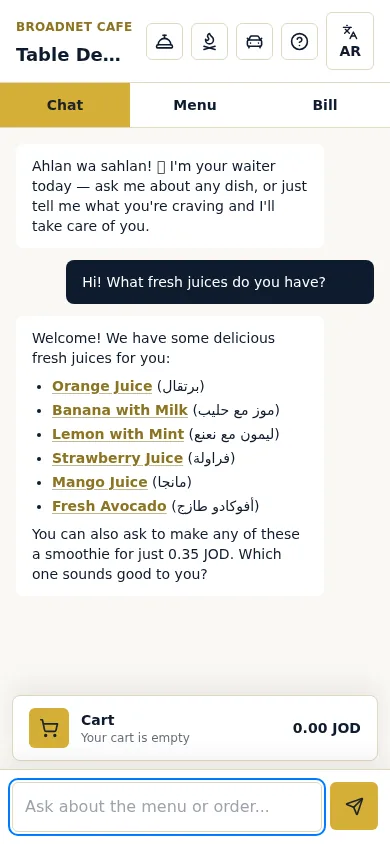
At Broadnet Cafe, BroadNet.AI’s own demo restaurant, the owner set Service 5% and Tax 7.5%, both on the food subtotal. On 15 October 2026 a 19.00 JOD subtotal showed 0.95 JOD service, 1.43 JOD tax and a 21.38 JOD total. Those are that restaurant’s choices, not defaults.
What it doesn’t do, so you can plan around it:
- No tip line. There is no guest tip feature. Tips stay with your staff and your terminal, as today.
- No payment, no receipt. WaiterPilot takes no payments. When a guest asks for the check from their phone, the request says cash or card, so the server brings the card machine. Your POS or terminal produces the receipt, so the separate-lines rule is met there.
- No automatic fee notice. WaiterPilot doesn’t write a fee notice into your menu by itself. If your rules require one wherever orders are placed, raise it when we load your menu, and check the result yourself before going live. You review the menu before it reaches guests either way.
See the bill screens on waiter call and bill. And on our side of the bill: WaiterPilot charges $200 per location per month, with 0% commission on orders and no contract, so it adds no per-order fee you would need to pass on (pricing).
A checklist before you add or change a fee
- Write down every charge that isn’t food, drink or tax, including card surcharges and delivery fees.
- For each one, decide the name, the rate or amount, who it applies to, and what it pays for.
- Decide whether a further tip is expected, and say so in writing.
- Put the notice on the printed menu, in type no smaller than your dish descriptions.
- Put the same notice wherever guests order: QR menu, website, app.
- Set the same name and rate in your bill or POS so the bill matches the menu.
- Check that the receipt shows tip, fee and tax on separate lines.
- Brief staff on one sentence that explains each fee.
- Ask your accountant how service charges run through payroll.
- Check your state or country rules, and re-check when they change.
What to do next
Start with step 1: list your fees and read them as a guest would. If any line would surprise you at the end of a meal, fix the wording before you fix anything else. If you take orders on guests’ phones, check that the fee shows wherever they order and on the bill they see. To see how a live bill shows your charges from the first order, try a sample order. This guide is not legal or tax advice; check your local rules.
Questions readers ask
Are restaurant service charges legal?
In many places, yes, as long as the guest is told clearly before ordering. Some places set rules on how the fee must be shown; Florida, for example, requires the amount or percentage and the purpose on the menu from 1 July 2026. This is not legal advice; check your local rules.
Can restaurants automatically add gratuity?
Many restaurants do, often for large parties, and it should be shown before the guest orders. The IRS treats an automatic gratuity as a service charge, not a tip, so it is generally handled as wages when paid to staff. Ask your accountant how that applies to your payroll.
Is a service charge the same as a tip?
No. The IRS says a payment is a tip only if the customer chooses to pay it and decides the amount. A charge the restaurant adds to every bill, or to some bills, is a service charge, whatever it is called on the menu.
What is the Florida restaurant fee law?
Section 509.214 of the Florida Statutes, amended by SB 606 with effect from 1 July 2026. It covers operations charges such as service charges, automatic gratuities, card surcharges and delivery fees, and requires a notice of the amount or percentage and the purpose, plus separate lines on the receipt.
Do I have to tip on top of a service charge?
A service charge isn't a tip, so whether a further tip is expected is up to the restaurant, and it should say so. Clear wording such as 'An 18% gratuity is added for parties of 8 or more. No further tip is expected' avoids the argument at the end of the meal.
Does WaiterPilot add a tip line to the bill?
No. WaiterPilot has no guest tip feature. It shows the tax, service charge or gratuity lines the restaurant sets on the guest's live bill, and guests pay your staff, who handle any tip the way they do today.
Sources
- CS/CS/SB 606 (2025): Public Lodging and Public Food Service Establishments, bill history, The Florida Senate, 2025-06-03 (checked 2026-10-16)
- CS/CS/SB 606 (2025), enrolled bill text (section 3 amends s. 509.214, effective 1 July 2026), The Florida Senate, 2025 (checked 2026-10-16)
- Florida Statutes s. 509.214, Notification of operations charge and public food service establishment receipts, Florida Legislature, Online Sunshine, 2026 (checked 2026-10-16)
- Tip recordkeeping and reporting, Internal Revenue Service, 2026-07-31 (checked 2026-10-16)
- Tipping Culture in America: Public Sees a Changed Landscape, Pew Research Center, 2023-11-09 (checked 2026-10-15)