Running service
How long should restaurant guests wait to order? A practical guide
There's no verified industry standard. Set house targets for the greeting, first order and check, measure them, and cut the waits caused by busy servers.

WaiterPilot Operations
Updated , 8 min read

The short answer
We found no verified industry standard for how long table-service guests should wait to order, so be wary of quoted ones. Set your own targets for four moments (the greeting, the first order, a request during the meal and the check), measure them on real nights, and cut the waits that come from guests needing a busy server. Phone ordering and a waiter call button shorten exactly those.
Key points
- No published, verified benchmark exists for table-service wait times; the research measures whole meals instead.
- A peer-reviewed study of tabletop ordering found meals about 10% shorter, with checks only about 1% higher.
- Most waits in a meal are waits for a server: to be greeted, to order, to ask something, to pay.
- Phone ordering lets a table order when it's ready, not when the server is free; the first order still waits for a staff Confirm.
- A waiter call shows on the floor screen within seconds, and waiting calls change color at 1, 5 and 10 minutes.
On this page
We found no verified industry standard for how long table-service guests should wait to order. Treat any precise “guests should be greeted within X seconds” rule you read as someone’s house policy, not a measured norm. What works is setting your own targets for four moments in the meal (the greeting, the first order, a request during the meal and the check), measuring them on real nights, and then cutting the waits that come from guests needing a server who is busy elsewhere.
This guide shows what the research does measure, walks through each wait, and gives a worksheet and a worked example. It also explains where ordering on the phone and a waiter call button help, and where they don’t.
Is there an industry standard for wait times?
Short answer: not one we could verify for table service. The research measures whole meals instead.
When we collected statistics for this blog, we looked for order-accuracy and wait-time benchmarks for table service. We found studies of drive-thrus, published by vendors, and no primary data for sit-down restaurants. So this post doesn’t give you an industry number, because we don’t have an honest one.
What has been measured is the length of the whole meal, and how it changes when guests can order or pay without waiting for a server. That turns out to be the useful question anyway.
What does the research say about waiting?
Short answer: when guests can order and pay without waiting for a server, meals get shorter. Checks barely change.
- Shorter meals, almost the same check. In a peer-reviewed study of a 66-restaurant US casual dining chain, tabletop ordering devices raised sales per check by about 1% and cut meal duration by about 10% (Tan and Netessine, Management Science, as reported by Restaurant Technology News, 2019). The time came out of the meal, not the bill.
- Faster table turns when paying was easier. In a 2016 Cornell report, checks paid on a tabletop device turned in 45 minutes 21 seconds, against 53 minutes 45 seconds for checks that weren’t, a 15.5% difference (Susskind and Curry, Cornell, 2016, p. 7). Guests chose whether to use the device, and one author worked for the device maker, so read it as an association, not proof.
- Less server time per table. In the same report, one restaurant observed server time per table fall from 10 minutes 16 seconds to 6 minutes 30 seconds when guests paid by device, and to 3 minutes 30 seconds when they ordered and paid by device (p. 6). That is a single restaurant and a small sample of tables.
Guests notice the same thing. In the National Restaurant Association’s 2024 survey of full-service diners, the top answers to where technology should help most were making paying easier and faster (30%) and making ordering easier and faster (28%); 21% named knowing when their food will arrive (NRA, 2024, p. 7).
These studies are about tablets and devices, not guests’ own phones or chat ordering. They don’t tell you how WaiterPilot will do in your restaurant. They do show where the minutes go: into waiting for a person.
What are the waits in a table-service meal?
Short answer: four main ones. Each has a start, an end and a usual cause.
| Moment | The guest waits for | Usual cause of delay | How phone ordering and a call button change it |
|---|---|---|---|
| Greeting | Someone to acknowledge them | Every server is at another table | Doesn’t change. The greeting stays a person’s job |
| Drinks and first order | A server to come back and take it | The server is taking other tables’ orders | The table orders by phone when it’s ready; staff confirm the first order |
| A question or a change | A server to notice them | Catching an eye in a busy room | The guest asks the chat, or calls a waiter from the phone |
| The check | The check to arrive, then the card machine | The server is busy; a second trip for the card machine | The guest asks from the phone; the request says cash or card |
The food itself is a fifth wait, but it belongs to the kitchen. Ordering faster doesn’t cook faster. It does get the ticket to the kitchen sooner.
Why do guests wait to order?
Short answer: because one server can only stand at one table at a time.
A server with five tables that sit down within a few minutes of each other has to take five orders in turn. The last table waits for the other four, however good the server is. That wait isn’t anyone’s fault; it’s arithmetic.
A worked example at Casa Olivo
Casa Olivo is a fictional restaurant we use for examples (an example, not a customer). The minutes below are assumptions, not measurements.
Assumptions: Marta has five tables. All five are ready to order between 19:30 and 19:35. Taking an order at the table, with a couple of menu questions, takes 4 minutes. Confirming a first order on her phone takes about 20 seconds.
Taking orders at the table:
| Table | Marta arrives | Order taken | Waited since ready (if ready at 19:30) |
|---|---|---|---|
| 1 | 19:30 | 19:34 | 4 minutes |
| 2 | 19:34 | 19:38 | 8 minutes |
| 3 | 19:38 | 19:42 | 12 minutes |
| 4 | 19:42 | 19:46 | 16 minutes |
| 5 | 19:46 | 19:50 | 20 minutes |
Five tables × 4 minutes = 20 minutes, and the last table waits all of it.
Ordering on the phone: each table orders when it’s ready. Marta confirms the five first orders from her phone: 5 × 20 seconds = 100 seconds of her time. She still visits each table to greet them and check in, but nobody waits for her to arrive before the kitchen sees the order.
The saving isn’t in the kitchen. It’s the 16 minutes table 5 no longer spends waiting for Marta to finish with tables 1 to 4.
How does ordering on the phone shorten the wait?
Short answer: the table orders when it’s ready, and the order reaches the staff board within seconds.
With WaiterPilot, guests scan the code on their table and the menu opens in the phone’s browser. They ask about dishes in the chat, which answers from your menu, and when the menu doesn’t say, it tells them to ask a member of staff. When they’re ready, they review the order and tap Confirm.
In our tests on 15 October 2026, four confirmed orders reached the staff board in 0.8 to 2.7 seconds. That’s four orders at our own quiet demo restaurant, so read it as “within seconds”, not as a promise for a full Saturday.
Then comes the wait you control. The first order at each table waits on the staff board as Awaiting staff until someone taps Confirm. That check is on purpose: a person sees every new table’s order before the kitchen starts. Later orders from the same table can go straight to the kitchen. To keep the first-order wait short:
- Name who confirms. One person, with a backup for breaks.
- Watch the colors. Waiting orders and calls change color on the board at 1, 5 and 10 minutes.
- Put the board where it’s seen. On a phone in that person’s pocket, or a tablet at the pass.
How does a waiter call button shorten the wait?
Short answer: the guest stops waiting to catch someone’s eye. The call shows up where staff can see it.
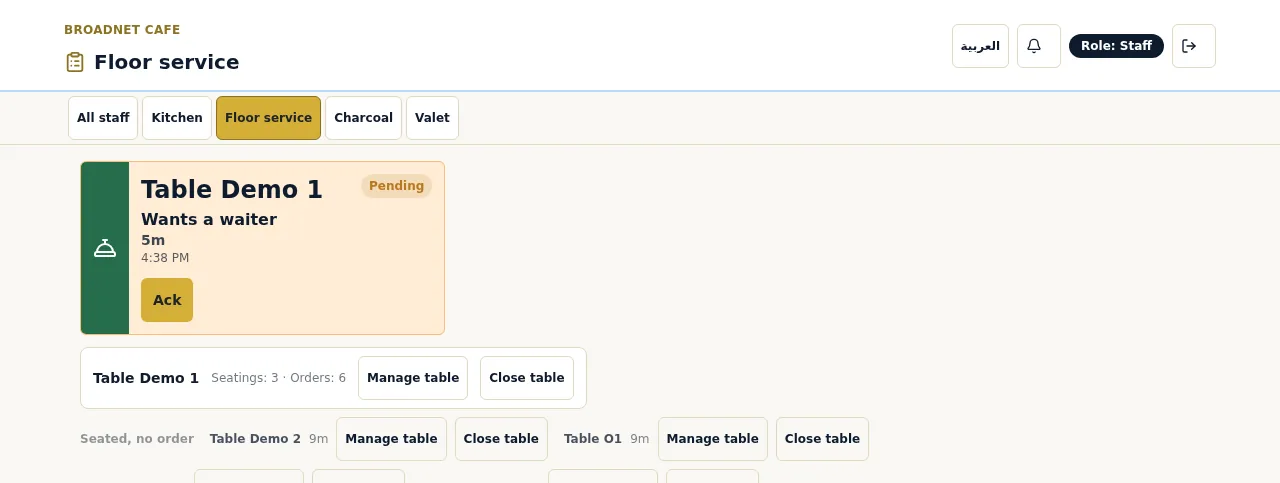
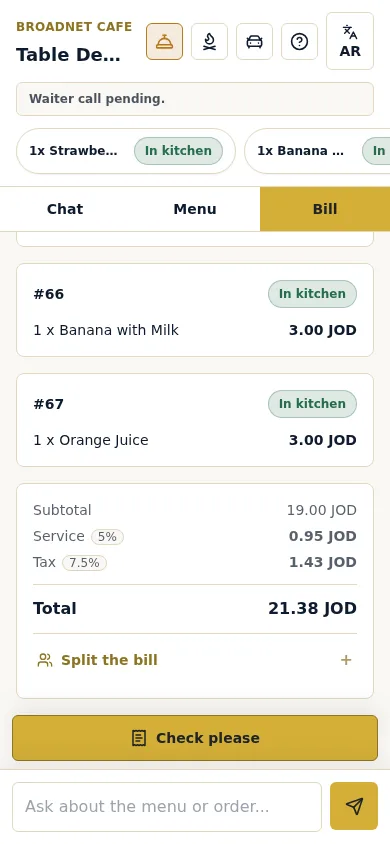
Much of the waiting in a meal is a guest looking around for a server: for more bread, another drink, a question, the check. With WaiterPilot the guest taps to call a waiter, and the call appears on the floor screen within seconds, with the table, “Wants a waiter” and how many minutes it has waited. The guest’s phone shows “Waiter call pending”. A server taps Ack so the team knows someone has it, then goes to the table.
Being able to reach a person matters to guests. In a 2026 survey of 1,000 US adults by PAR Technology, which sells restaurant software, 44% said AI goes too far when they “cannot easily reach a person” (QSR Web, 2026). A waiter call is that person, one tap away.
How long should guests wait for the check?
Short answer: as little as possible once they’ve asked. This is the wait guests notice most at the end of a meal.
The check usually takes two trips: one to bring it, another to bring the card machine. With WaiterPilot the guest asks for the check from the phone, and the request says whether they’ll pay by cash or card, so the server brings the card machine on the first trip. The live bill is already on every phone at the table, and guests can split it evenly or see just their own share. Payment is taken by your staff, as today; WaiterPilot doesn’t process payments.
How do you measure waits in your own restaurant?
Short answer: time four moments on a few real nights, then set targets you can hit.
Use this worksheet. The Casa Olivo column is an example of house targets, not an industry standard.
| Wait | Starts | Ends | Casa Olivo target (example) | Your target | Measured |
|---|---|---|---|---|---|
| Greeting | Guests seated | First contact from staff | 2 minutes | ||
| First order | Guests ready to order | Order confirmed | 5 minutes | ||
| A waiter call | Guest calls | Server at the table | 3 minutes | ||
| Check | Guest asks | Payment taken | 5 minutes |
How to time them:
- Pick three nights: a quiet one, a normal one and your busiest.
- Ask a manager to note times for ten tables each night, from seated to paid.
- Look for the wait with the widest spread. That’s usually where a server is overloaded.
- Set a target for it, change one thing, and measure again on the same night of the week.
WaiterPilot’s owner analytics help with part of this. They show how long staff take to confirm orders, how long the kitchen takes to serve, and how fast waiter calls are answered. The greeting is still yours to time by hand.
Doesn’t cutting waits rush guests?
Short answer: not when the guest sets the pace.
A shorter wait to order isn’t the same as a shorter meal for every table. A couple lingering over dessert isn’t waiting; they’re enjoying the evening. The waits worth cutting are the ones the guest didn’t choose: waiting to be noticed, to order, to ask, to pay. Phone ordering and a waiter call let guests order and ask for the check when they’re ready, which is the opposite of a server hovering with the bill.
What to do next
Time your four waits on three nights this week, using the worksheet above. Then see where a phone and a call button would change them: waiter call and bill shows the call and check screens, and how it works shows the order flow. For the peak-hour side, read our restaurant rush hour playbook and how to increase table turnover without rushing guests. Or try a sample order and time it yourself.
Questions readers ask
Is there an industry standard for how long guests should wait to order?
Not one we could verify. We found no primary data on table-service wait times, only drive-thru studies published by vendors. Set your own house targets and measure them.
How quickly should a server greet a table?
Soon enough that the guests know they've been seen, even if the server can't stay. Pick a house target you can hit on your busiest night and measure it; we found no verified industry standard to copy.
Does ordering on the phone mean guests never wait?
No. Ordering by phone removes the wait for a server to come and take the order. With WaiterPilot the first order at a table still waits for a staff member to tap Confirm, and the kitchen still takes the time it takes.
Will shorter waits rush my guests?
Not if the guest sets the pace. Phone ordering and a waiter call let guests order and ask for the check when they're ready, which is the opposite of a server hovering.
How can I measure waits in my restaurant?
Time four moments on a few real nights: seated to greeted, ready to order to order confirmed, waiter called to server at the table, and check asked to payment taken. WaiterPilot's owner analytics also show time to staff confirm, kitchen to served and how fast waiter calls are answered.
Sources
- Research: tabletop technology improves sales 1% per check, reducing meal duration 10%, Restaurant Technology News (reporting Tan and Netessine, Management Science), 2019-07 (checked 2026-10-15)
- The Influence of Table Top Technology in Full-service Restaurants (Cornell Hospitality Report 16(22)), Susskind and Curry, Cornell Center for Hospitality Research, 2016-10-06 (checked 2026-10-15)
- Restaurant Technology Landscape Report 2024, National Restaurant Association, 2024 (checked 2026-10-15)
- 3 in 4 diners open to restaurant AI, PAR survey finds, QSR Web (reporting PAR Technology's 2026 Industry Report), 2026-08-24 (checked 2026-10-15)