Running service
How to split the bill at a restaurant: evenly, by dish or by phone
Three ways to split one restaurant bill, worked out on a four-person table with tax and a service charge, and where payment happens when guests split on phones.

WaiterPilot Operations
Updated , 10 min read
The short answer
There are three common ways: split evenly, split by dish (each guest pays for what they had), or split by phone, where each share comes from what was ordered on that phone. Percentage charges such as tax and a service charge follow the food in every method. With WaiterPilot, guests see the split on their phones and then pay your staff; it takes no payment.
Key points
- Splitting evenly is the fastest at the terminal; splitting by dish is the fairest when orders differ a lot.
- Splitting by phone is quick, but a shared plate counts against the phone that ordered it, so someone may need to even up.
- Percentage charges such as tax and a service charge follow each guest's food, so every method still adds up to the same total.
- WaiterPilot shows Split evenly and Just my share on the guest's live bill; payment happens on your own terminal or in cash.
- There is no tip button in WaiterPilot. Only the tax, service charge or gratuity lines the restaurant sets appear on the bill.
On this page
There are three common ways to split a restaurant bill: evenly, by dish, or by phone, where each guest’s share comes from what was ordered on their own phone. Tax and any service charge follow the food in every method, so the shares always add up to the same total. With WaiterPilot, guests see the split on their phones and then pay your staff the way they do today. WaiterPilot takes no payment.
Below, one four-person table at Casa Olivo is worked out every way, with the arithmetic shown, so you can see who pays what, where the shared plates go, and what your server does at the terminal.
What are the ways to split a restaurant bill?
Short answer: evenly, by dish, by phone, or one person pays. Each trades speed against fairness.
| Method | How it works | Fast at the terminal? | Fair when orders differ? | Shared plates |
|---|---|---|---|---|
| Split evenly | Total ÷ number of people | Yes: one amount, several cards | No | Shared equally, automatically |
| By dish | Each guest pays for their own items plus a part of shared plates | No: the server works out each amount | Yes | Someone decides how to share them |
| By phone | Each guest pays for what was ordered on their phone | Yes, if guests show their amount | Mostly | Counted on the phone that ordered them |
| One person pays | One card, the table settles up later | Yes | Not your problem | Not your problem |
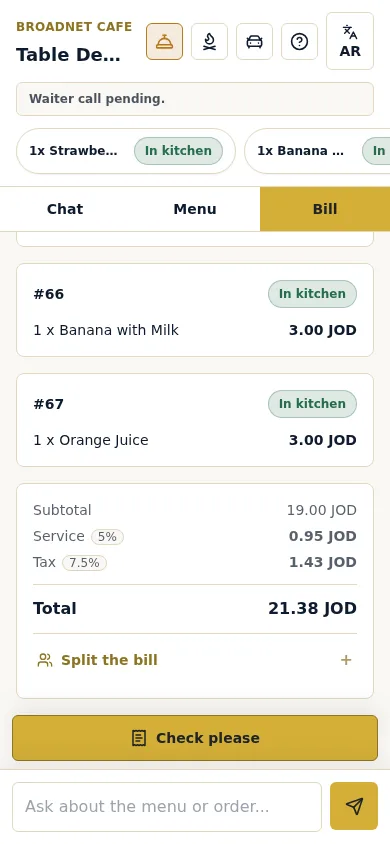
WaiterPilot offers two of these on the guest’s live bill: Split evenly and Just my share (what this phone ordered). It does not let guests tick dishes off a shared list. A by-dish split happens at your terminal, the way it does today. More on the screens in waiter call and bill.
How does each method work out on one table?
Casa Olivo is a fictional restaurant we use for examples (an example, not a customer). The prices and charge rates are our assumptions, not WaiterPilot defaults and not tax advice.
Table 7 is four friends: Ana, Ben, Chen and Dalia. Ana orders for herself and Ben on her phone. Chen and Dalia order on their own phones. Chen orders a mezze board for the table; Dalia orders a dessert platter for the table.
Casa Olivo has set two bill lines: Service 10% and Tax 8%, both counted on the food subtotal.
What each phone ordered
| Phone | Items | Food |
|---|---|---|
| Ana’s (for Ana and Ben) | Mushroom risotto $22, sea bass $28, two glasses of wine $24 | $74.00 |
| Chen’s | Mezze board to share $18, steak $34, sparkling water $4 | $56.00 |
| Dalia’s | Pasta $20, lemonade $6, dessert platter to share $14 | $40.00 |
| Food subtotal | $170.00 | |
| Service 10% | 10% of $170 | $17.00 |
| Tax 8% | 8% of $170 | $13.60 |
| Total | $200.60 |
Method 1: split evenly. $200.60 ÷ 4 = $50.15 each. One number, four cards, done.
Method 2: by dish. Each person’s own items, plus a quarter of the two shared plates ($18 + $14 = $32, so $8 each). Then add the 18% of charges (10% service plus 8% tax) on each person’s food.
| Guest | Own items | Plus shared | Food | With 18% charges |
|---|---|---|---|---|
| Ana | Risotto $22, wine $12 = $34 | $8 | $42 | $49.56 |
| Ben | Sea bass $28, wine $12 = $40 | $8 | $48 | $56.64 |
| Chen | Steak $34, water $4 = $38 | $8 | $46 | $54.28 |
| Dalia | Pasta $20, lemonade $6 = $26 | $8 | $34 | $40.12 |
| Total | $170 | $200.60 |
Method 3: by phone (Just my share). Each phone’s food plus the same 18% of charges on that food.
| Phone | Food | Service 10% | Tax 8% | Share |
|---|---|---|---|---|
| Ana’s (Ana and Ben) | $74.00 | $7.40 | $5.92 | $87.32 ($43.66 each) |
| Chen’s | $56.00 | $5.60 | $4.48 | $66.08 |
| Dalia’s | $40.00 | $4.00 | $3.20 | $47.20 |
| Total | $170.00 | $17.00 | $13.60 | $200.60 |
Side by side, per person
| Guest | Evenly | By dish | By phone |
|---|---|---|---|
| Ana | $50.15 | $49.56 | $43.66 |
| Ben | $50.15 | $56.64 | $43.66 |
| Chen | $50.15 | $54.28 | $66.08 |
| Dalia | $50.15 | $40.12 | $47.20 |
| Table | $200.60 | $200.60 | $200.60 |
Every column adds up to the same $200.60. What changes is who carries what.
Who pays for the shared plates?
Short answer: in a split by phone, the phone that ordered them. That is the one catch with phone-based splits.
Look at Chen. By dish he owes $54.28. By phone he owes $66.08, because the whole mezze board sits on his phone. Dalia carries the whole dessert platter the same way. Ana and Ben pay less by phone than by dish, because one phone ordered for two people and they split it between them.
Nothing is wrong with the numbers. A phone can only know what was ordered on it. So when a table shares a lot, tell guests (or have your servers tell them) that they have three easy fixes:
- Use Split evenly instead, which shares everything equally.
- Use Just my share and settle the shared plates between themselves.
- Ask the server to split by dish at the terminal.
The even split also asks how many people are sharing, because one phone can be ordering for two. At table 7 that matters: there are three phones but four people.
Where do tax and service charges go in a split?
Short answer: they follow the food. A percentage of the total is the same percentage of each share.
In the by-phone table above, Chen’s $56 of food carries $5.60 of service and $4.48 of tax, exactly 10% and 8% of his food. Add the three phones’ lines together and you get the table’s $17.00 and $13.60 again. That is why every method lands on $200.60.
In WaiterPilot you set these lines yourself. The bill shows tax and any service charge or gratuity you choose, at your rates, and updates as the table orders more. At Broadnet Cafe, BroadNet.AI’s demo restaurant, the owner set Service 5% and Tax 7.5% on the food subtotal: a 19.00 JOD subtotal came to 0.95 JOD service, 1.43 JOD tax and a 21.38 JOD total. Those are that restaurant’s choices, not defaults. If your local rules say how a service charge must be shown or shared, follow them; we don’t give tax or legal advice.
Where does payment happen when guests split on their phones?
Short answer: with your staff, on your terminal or in cash. WaiterPilot shows the split; it doesn’t take the money.
Here is how table 7 pays at Casa Olivo:
- Dalia taps Check please on the Bill tab (or asks in the chat). The chat asks: “Will you be paying with cash or card?”
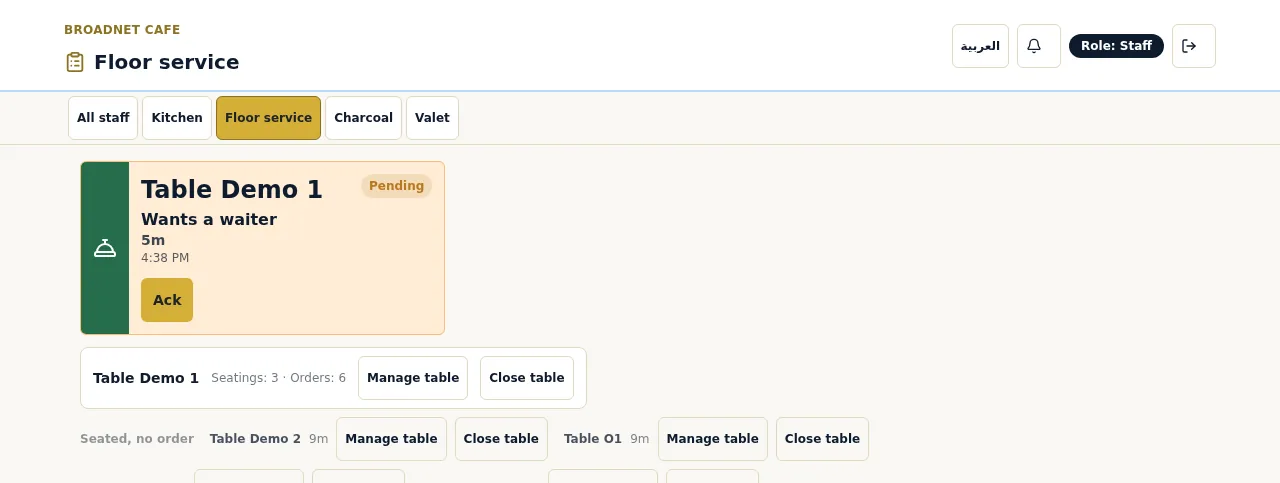
- The check request appears on the floor screen within seconds, with the answer, so Marta, the server, knows to bring the card machine.
- Each guest opens Split the bill and shows Marta their amount: $50.15 each if they split evenly, or their phone’s share.
- Marta keys each amount into the card terminal, or takes cash.
- Marta closes the table on the staff screen, and rings the sale into the till if Casa Olivo uses one.
Two things to know. First, the staff screens show the check request, not the guests’ chosen split, so the guest shows the amount on their phone. Second, WaiterPilot has no POS connection, so the till doesn’t know about the split either. Your server enters the amounts on the terminal, the same as with a paper bill. The works with your POS page explains the till step.
If you want guests to pay on their phones, a pay-at-table tool fits better than WaiterPilot. Our guide to pay at table vs order at table compares the two honestly. The research on speed points the same way: in one Cornell study, guests who paid on a tabletop device had a table-turn time of 45 minutes 21 seconds, against 53 minutes 45 seconds for those who didn’t (Susskind and Curry, Cornell, 2016). That gain came from paying at the table, which WaiterPilot doesn’t do. What it can save is the wait to get the check and the arithmetic at the table.
Guests do care about this step. When the National Restaurant Association asked full-service diners in 2024 where technology should help most, 30% picked making paying easier and faster, just ahead of ordering (28%) (NRA, 2024).
What about tips?
Short answer: WaiterPilot has no tip button. Guests tip at payment, the way they do now.
Tipping at a sit-down meal is still the norm in the US: 92% of adults say they “always or often leave a tip” at sit-down restaurants (Pew Research Center, 2023). The same survey found 40% oppose businesses suggesting tip amounts, against 24% in favor.
With WaiterPilot the bill shows only the lines you set. If you add a gratuity, it is a fixed line like any other charge, not a choice the guest makes on the phone. Guests who want to tip on top do it on your card terminal or in cash. If you charge a service charge or gratuity, say so on your menu and make sure servers can explain it, so a guest splitting the bill isn’t surprised by a line they didn’t expect. For more on this, see tipping and QR ordering.
How do split habits differ by country?
Short answer: the words differ, and so does whether a tip is expected. Here is what guests type when they look it up.
These phrases come from our keyword research in October 2026 (search suggestions, not volumes). They tell you how guests from each market think about the split.
| Language | Phrase guests search | What it means |
|---|---|---|
| Italian | conto alla romana | Split evenly (“Roman style”) |
| Spanish | dividir la cuenta (en partes iguales) | Split the bill (evenly) |
| Portuguese (Brazil) | dividir a conta (proporcionalmente) | Split the bill (in proportion) |
| French | partager l’addition | Share the bill |
| German | Rechnung teilen, getrennt zahlen | Split the bill, pay separately |
| Arabic | تقسيم الفاتورة | Split the bill |
| Japanese | 割り勘 (warikan) | Splitting the bill, common in Japan |
| Korean | 더치페이, N빵 | “Dutch pay”, splitting by N people, common in Korea |
Two practical notes. Guests from Japan and Korea don’t expect to tip at home, so a tip prompt on your card terminal may confuse them. And a group that asks to pay “separately” may mean by dish, not evenly; a quick question at the table saves a re-run at the terminal. WaiterPilot’s chat answers in the guest’s language (tested in English, Arabic and Spanish), but the screen buttons, Split the bill included, are in English or Arabic, so a server may need to point to the right one. See serving tourists who don’t speak your language.
What should you set up before guests start splitting?
Use this list before your first service with phone-based splits:
- Set your bill lines. Tax, and any service charge or gratuity, at your rates. Check one bill by hand against your till.
- Decide the house rule for shared plates. For example: “If you shared a lot, we suggest Split evenly.”
- Teach servers to read the guest’s screen. The amount to charge is on the guest’s phone, not on the staff board.
- Practice a three-card split on the terminal. Most delays at payment are the terminal, not the maths.
- Agree who closes the table on the staff screen after payment, so the next party starts with a clean bill.
- Decide where the till step happens if you use a POS: as orders are confirmed, or at the check.
- Explain tipping in your own words. WaiterPilot shows no tip line; your terminal or cash handles tips.
What to do next
Work out one of your own busy tables the three ways above, with your real charges, and see where the shared plates land. Then try a sample order to see the live bill and the split from the guest’s side. It’s a simulation in your browser, with no real order placed. If you decide it fits, WaiterPilot is $200 per location per month after 30 days free, with 0% commission and no contract; the details are on the pricing page.
Questions readers ask
What is the fairest way to split a restaurant bill?
Splitting by dish is the fairest when guests ordered very different amounts, because each person pays for what they had plus their part of shared plates. Splitting evenly is faster and works well when orders are close in price.
Do tax and service charges get split too?
Yes. A percentage charge applies to the food, so in a split each guest carries the same percentage on their own share. In every method the shares should add up to the same total.
Can guests split the bill in WaiterPilot?
Yes. On the live bill guests can split the total evenly or see just their own share, meaning what was ordered from their phone. They then pay your staff in cash or on your card terminal, because WaiterPilot takes no payment.
Can guests add a tip in WaiterPilot?
No. There is no tip button. The bill shows only the lines the restaurant sets, such as tax, a service charge or a gratuity. Guests who want to tip do it at payment, on your terminal or in cash.
What happens to a dish everyone shared when guests split by phone?
It counts in full on the phone that ordered it. If the table wants to share its cost, they can split evenly instead, or settle the difference between them, or ask your server to split by dish at the terminal.
Sources
- Tipping Culture in America: Public Sees a Changed Landscape, Pew Research Center, 2023-11-09 (checked 2026-10-15)
- Restaurant Technology Landscape Report 2024, National Restaurant Association, 2024 (checked 2026-10-15)
- The Influence of Table Top Technology in Full-service Restaurants (Cornell Hospitality Report 16(22)), Susskind and Curry, Cornell Center for Hospitality Research, 2016-10-06 (checked 2026-10-15)