Running service
How to upsell in a restaurant without being pushy
Suggest, don't push: what research says upselling and tabletop ordering really add, the moments and phrases that help guests, and what an AI waiter should do.

WaiterPilot Operations
Updated , 8 min read
The short answer
Upsell by helping guests choose, not by pushing: suggest one specific thing at the right moment, describe it, offer a choice and accept no gracefully. Don't expect a big jump in the check. The best peer-reviewed study of tabletop ordering found about 1% more per check; the popular 20% to 30% figures trace to a hypothetical example and vendor marketing.
Key points
- Good upselling is a recommendation the guest is glad to hear: one specific item, at the moment they're deciding, with an easy way to say no.
- The best peer-reviewed study of tabletop ordering found about 1% more per check and about 10% shorter meals; expect small gains, not a jump.
- Measure suggestions by attach rate, such as the share of mains ordered with a side, on the same weekday before and after.
- In the Casa Olivo example, raising side attach from 30% to 35% adds $120 a week, about 0.4% of sales: real but small.
- WaiterPilot asks about required choices and may ask once whether a guest would like anything with a dish; it has no upsell rules, and we make no check-size claim.
On this page
Upsell by helping guests choose, not by pushing. Suggest one specific thing at the moment they’re deciding, describe it in a sentence, offer a choice and take no for an answer the first time. That’s what guests hear as good service. And set your expectations honestly: the best peer-reviewed study of tabletop ordering found about 1% more per check, and the popular 20% to 30% figures trace to a hypothetical example and vendor marketing. This post covers the research, the moments and phrases that work, how to train for it and how to measure it.
What does upselling mean in a restaurant?
Short answer: suggesting something the guest may want, either a better version of what they chose or something to go with it.
Two kinds get called upselling:
- Upselling: a pricier version of the same choice. A larger glass, the dry-aged steak, the premium gin.
- Suggestive selling or cross-selling: something to go with it. A side, a sauce, a drink that suits the dish, dessert.
The second kind is usually the easier one to do well, because it answers a question the guest is already asking themselves: “what goes with this?” Pushy upselling is the version where the suggestion serves the check and not the guest. Guests can tell the difference within a sentence.
Does upselling actually increase the check? What research says
Short answer: a little. Expect small, steady gains, not a jump.
| Source | What it says | What it is |
|---|---|---|
| Tan and Netessine, Management Science (peer reviewed) | About 1% more per check and about 10% shorter meals with tabletop ordering devices, in a 66-restaurant US casual chain | The strongest evidence available |
| Cornell Hospitality Report, 2016 | “If the tabletop technology can improve the average guest check by just $3, that would result in a 20-percent improvement considering a restaurant average check of $15” | A hypothetical illustration in the report, not a finding |
| Butlaroo (vendor) | “30% lift in average cover value vs. traditional service” | A vendor claim, as published on 15 Oct 2026 |
| AI-Waiter.com (vendor) | “UP TO +25% AVG CHECK INCREASE” | A vendor claim, as published on 15 Oct 2026 |
Sources: Restaurant Technology News, 2019, reporting Tan and Netessine; Susskind and Curry, Cornell, 2016, p. 4; Butlaroo; AI-Waiter.com.
The study measured tabletop devices, not servers’ technique, but it is the best evidence on whether prompting guests at the table moves the check. It moved it about 1%. The vendor figures may be true for someone, but none of the pages we read gave a sample, a time period or a comparison group. We go through the evidence in full in does tabletop ordering increase check size?.
The practical lesson: upselling is worth doing well because it’s part of good service, and it adds up over a year. It is not a strategy that rescues a thin margin on its own.
Which upselling techniques work without being pushy?
Short answer: specific, well-timed, described, optional and once.
- Name one thing. “Would you like anything else?” gets a no. “The grilled halloumi goes well with that salad” gets a decision.
- Pair it with what they chose. A suggestion that fits the guest’s order sounds like knowledge. A random special sounds like a script.
- Describe it in one sentence. What it is and why it’s good: “it’s charred on the grill, with honey and thyme”.
- Offer a choice, not a yes or no. “Fries or a green salad with that?” is help with a decision the guest needs to make anyway.
- Suggest once. If the answer is no, the subject is closed. A second try is where helpful turns pushy.
- Read the table. A couple lingering over dinner may want dessert ideas. A business lunch watching the clock wants the check.
- Be honest. If a guest asks whether they need the side, and the dish is a full plate, say so. Guests come back to servers they trust.
- Never upsell around allergies. If a guest mentions an allergy, the conversation is about safety, and staff have the final say.
What should a server say? Helpful versus pushy
Short answer: the same suggestion can be either. The wording and the timing decide.
Example wording; the dishes and prices are illustrations.
| Moment | Helpful | Pushy |
|---|---|---|
| Drinks order | “We have a local rosé that’s lovely with the mezze; would you like to try a glass?” | “Can I start you with a bottle of wine?” |
| Main ordered | “That comes with fries or a green salad. Which would you like?” | “Do you want to add a side? Most people do.” |
| Guest unsure between two dishes | “The lamb is richer; the fish is lighter. If you’re sharing starters, the fish might be better.” | “Go for the lamb, it’s our best seller.” |
| Upgrade | “The dry-aged steak is $8 more and has a deeper flavour. Happy to bring either.” | “You’ll want the dry-aged, trust me.” |
| After the guest said no | “No problem.” | “Are you sure? It’s really good.” |
| Dessert | “We’ve got a pistachio cake today, made this morning. Worth saving room for, or just coffee?” | Bringing the dessert menu to a table that asked for the check |
The helpful column has three things in common: a specific item, a reason, and an easy way out.
When is the right moment to suggest something?
Short answer: when the guest is already deciding. Before that it’s noise; after it, it’s an interruption.
- Drinks: at the greeting, when the guest is choosing anyway.
- Starters and sides: when the main is chosen, as a choice that completes the order.
- Upgrades: when the guest hesitates between versions, not after they’ve decided.
- Dessert and coffee: when plates are cleared and the table seems unhurried.
- Never: after the check is requested, during an allergy conversation, or to a table that has said no.
How do you train staff on upselling?
Short answer: taste, pick, practise and agree when to stop.
- Taste the menu. Servers can’t describe what they haven’t tried. Put suggested items into pre-shift tastings.
- Pick one or two suggestions per course and write down the one-sentence description for each.
- Practise out loud in pairs, both the suggestion and the “no problem”.
- Agree the rules: suggest once, offer a choice, never around allergies, read the table.
- Measure, don’t pressure. Share attach rates as a team number, not a leaderboard that rewards the pushiest server.
How can the menu do the suggesting?
Short answer: by turning suggestions into clear choices and short descriptions, so guests find them without anyone selling.
- Make sides and sizes a choice in the dish itself, with the options listed, rather than a separate section guests skip.
- Write one-line pairings under dishes: “good with the house white”.
- Describe dishes in plain words. Guests order what they understand.
- Keep the list short. Ten good suggestions beat forty that nobody reads.
This matters more when guests order from their phones, because the menu does the talking. Our guide to preparing your menu for digital ordering covers how to write choices and descriptions.
Can an AI waiter upsell? What WaiterPilot does
Short answer: WaiterPilot asks about choices and may ask once if a guest wants anything with a dish. It has no upsell rules, and we make no check-size claim.
What it does:
- Asks about required choices. If a dish needs a size, side or flavour, the guest must pick one before the order can be confirmed. That’s the “fries or salad?” question, asked every time.
- May ask once. After a guest adds a dish, WaiterPilot may ask once whether they’d like anything with it, the way a good server would.
- Answers from your menu. Guests ask questions in their own words and the answers come from your menu; when it doesn’t say, WaiterPilot tells the guest to ask a staff member.
- Leaves allergies to staff. It gives what the menu says and asks the guest to confirm with staff, who always have the final word.
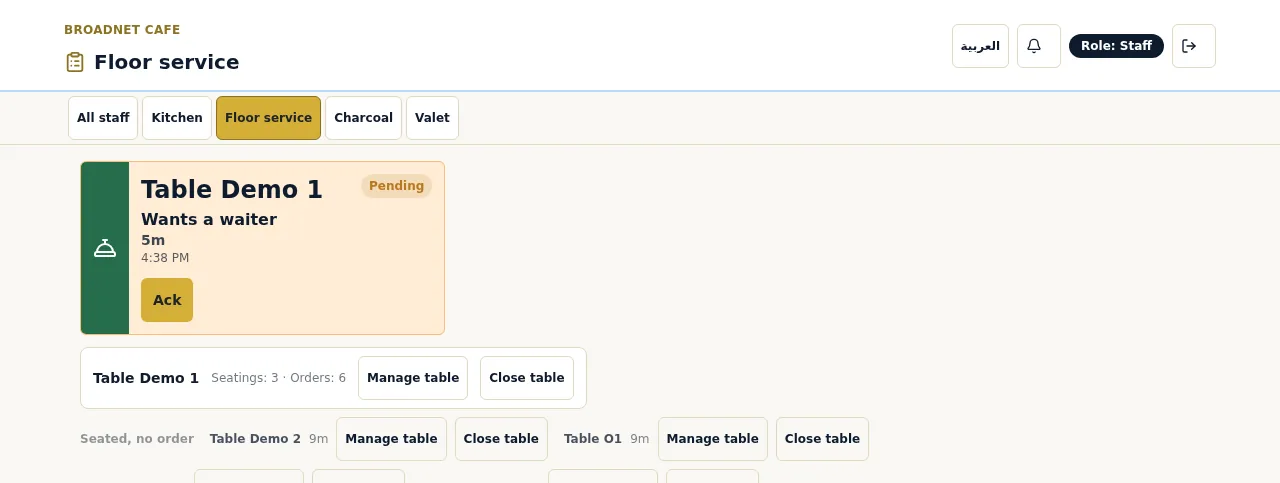
In our test at BroadNet.AI’s demo café on 15 Oct 2026, the chat listed fresh juices from the menu, offered to make any of them a smoothie (an option on that menu, for 0.35 JOD), and after a juice was added, asked once whether the guest wanted anything else. That is one observed run at a demo restaurant, not a measured result.
What it doesn’t do: no upsell scripts, no pairing rules and no suggestions the owner sets up. And no claim that checks get bigger. Some vendors advertise large percentage lifts from their AI; see the table above for what those claims rest on. If your main goal is a pushier sales tool, WaiterPilot isn’t built for that. For what an AI waiter is for, read what is an AI waiter or see the AI waiter page.
How do you measure whether suggestions work?
Short answer: by attach rate on the same weekday before and after, not by the average check.
Attach rate = orders that include the suggested item ÷ orders of the dish it goes with
Casa Olivo is a fictional restaurant (an example, not a customer). The figures are assumptions to show the arithmetic.
- Casa Olivo sells 400 mains a week, and 120 of them come with a paid side: an attach rate of 30%.
- After training servers to offer “fries or a green salad?” with every main, the attach rate on the same weekdays rises to 35%: 140 sides.
- The 20 extra sides at $6 each add $120 a week.
- Against weekly sales of $32,000, that’s 0.4%.
That is roughly the scale the research suggests: real money over a year ($120 × 52 = $6,240), but small against total sales. Track attach rate by item and by weekday, and ignore the average check for this purpose; it moves with prices, party sizes and season. If your ordering tool reports top dishes, read it alongside the other numbers that matter.
What to do next
- Pick one suggestion per course and write the one-sentence description for each.
- Practise the wording with the team, including “no problem”.
- Measure the attach rate for those items on the same weekdays for two weeks before and two weeks after.
To see how WaiterPilot handles choices in a real order, try a sample order. To compare AI waiter tools on what they claim and what they show, see our comparisons.
Questions readers ask
How do you upsell in a restaurant without being pushy?
Make one specific suggestion at the moment the guest is deciding, describe it in a sentence, offer a choice rather than a yes or no, and accept no without a second try. Guests hear that as help, not selling.
What are the best upselling techniques for servers?
Know and taste the menu, suggest a named item instead of asking 'anything else?', pair it with what the guest already chose, offer two options, and read the table: a business lunch in a hurry wants speed, not dessert ideas.
Does upselling increase the average check?
A little. The best peer-reviewed study of tabletop ordering found about 1% more per check. Larger percentages usually come from vendor marketing or from a hypothetical example in a 2016 Cornell report, not from measured results.
How do you train restaurant staff to upsell?
Have them taste the dishes they'll suggest, give each course one or two named suggestions, practise the wording out loud, and agree when not to suggest anything. Allergy questions always go to staff, who have the final say.
Can an AI waiter upsell?
Some vendors say theirs does. WaiterPilot asks about required choices such as size or side, and after a guest adds a dish it may ask once whether they'd like anything with it. It has no upsell rules, and we make no check-size claim.
What is the difference between upselling and suggestive selling?
Upselling means suggesting a pricier version of what the guest chose, such as a larger size. Suggestive selling, or cross-selling, means suggesting something to go with it, such as a side or a drink. Both work best as help with a choice.
Sources
- Research: tabletop technology improves sales 1% per check, reducing meal duration 10%, Restaurant Technology News (reporting Tan and Netessine, Management Science), 2019-07 (checked 2026-10-15)
- At Your Service on the Table (working paper version), Tan and Netessine, Wharton School, 2017-09-10 (checked 2026-10-15)
- The Influence of Table Top Technology in Full-service Restaurants (Cornell Hospitality Report 16(22)), Susskind and Curry, Cornell Center for Hospitality Research, 2016-10 (checked 2026-10-15)
- Restaurant Technology Landscape Report 2024, National Restaurant Association, 2024 (checked 2026-10-15)
- Vivi AI waiter, Butlaroo, 2026 (checked 2026-10-15)
- AI-Waiter.com home page, AI Waiter Systems, 2026 (checked 2026-10-15)