Running service
How to increase table turnover without rushing guests
Cut the waits guests didn't choose (for a server, the check, the card machine), not the meal. The formula, a worked 20-table example and what research found.

WaiterPilot Operations
Updated , 9 min read
The short answer
Shorten the minutes guests spend waiting, not the minutes they spend eating. Waiting for a server to take the order, for the check and for the card machine adds nothing to the meal. In a peer-reviewed study of a 66-restaurant chain, tabletop devices cut meal duration by about 10%. Faster turns only pay off when guests are waiting for tables.
Key points
- Table turnover rate is parties seated divided by tables for a service; average table time is total seated minutes divided by parties.
- The minutes worth cutting are the waits guests didn't choose: waiting to order, waiting for the check and waiting to pay.
- A peer-reviewed study of a 66-restaurant US chain found tabletop devices cut meal duration by about 10% and raised checks by only about 1%.
- In our fictional Casa Olivo example, cutting 8 waiting minutes from an 80-minute stay seats about 4 more parties on a 3-hour Friday, but only because there is a waitlist.
- On a night with empty tables, a faster turn adds nothing, so time your own waits before you change anything.
On this page
You increase table turnover without rushing guests by cutting the minutes they spend waiting, not the minutes they spend eating. A typical meal holds several waits nobody asked for: for a server to take the order, for another round, for the check, for the card machine. Remove those and tables free up sooner while the meal itself stays the same length. The best research points the same way: in a peer-reviewed study of a 66-restaurant chain, tabletop devices cut meal duration by about 10%.
This guide gives you the formula, a minute-by-minute map of a meal, a worked 20-table example with every assumption stated, and a way to measure your own turns before you change anything.
How do you calculate table turnover rate?
Short answer: parties seated in a service divided by the number of tables. Twenty tables that seat 40 parties between 6 pm and 9 pm turned 2.0 times.
Four numbers do most of the work:
| Measure | Formula | Casa Olivo example |
|---|---|---|
| Table turnover rate | Parties seated ÷ tables | 40 ÷ 20 = 2.0 |
| Average table time | Total minutes parties sat ÷ parties | 80 minutes |
| Table cycle | Average table time + minutes to clear and reset | 80 + 10 = 90 minutes |
| Possible turns in a service | Service minutes ÷ table cycle | 180 ÷ 90 = 2.0 |
Your POS gives you most of this: check open and close times stand in for seating and leaving. Count parties, not covers, for the turnover rate, and track covers separately, since a two-top seated at a six-top turns the table but wastes four seats.
People often ask what a “good” rate is. We found no independent benchmark we could verify, and a café and a tasting menu shouldn’t share one anyway. Compare each Friday with earlier Fridays.
Where do the minutes of a meal go?
Short answer: mostly to eating and the kitchen, which you shouldn’t squeeze, and partly to waiting, which you can.
Here is a map of an 80-minute dinner at Casa Olivo. Casa Olivo is a fictional restaurant (an example, not a customer); these minutes are assumptions for illustration, not measurements.
| Stage | Minutes | Whose time is it? | Shorten it without rushing? |
|---|---|---|---|
| Seated, reading the menu, talking | 4 | The guests’ | No |
| Ready to order, waiting for a server | 4 | Nobody’s | Yes |
| Order to food on the table | 18 | The kitchen’s | Only with kitchen work |
| Eating and talking | 40 | The guests’ | No, never |
| Ready to leave, waiting for the check | 8 | Nobody’s | Yes |
| Waiting for the card machine, paying | 6 | Partly nobody’s | Partly |
| Total at the table | 80 |
In this example, 18 of 80 minutes are waiting the guests didn’t choose. That’s the budget. Everything else belongs to the guests or the kitchen, and cutting it is what “rushing” means.
Guests notice the waits more than the meal. Nobody minds a long dessert. Many people mind sitting with their coats on, trying to catch someone’s eye for the check.
What did the research find about faster turns?
Short answer: tabletop ordering shortened meals by about 10% in the best study, while checks barely moved.
- The peer-reviewed study. Tan and Netessine followed a 66-restaurant US casual-dining chain that added tabletop devices restaurant by restaurant. The published version in Management Science reports about +1% per check, about −10% meal duration and about +11% sales per minute, from 2.6 million transactions in 2012 to 2014 (Restaurant Technology News, 2019).
- The Cornell report. In 45 restaurants of one chain in January 2016, guests who paid on the tabletop device had a table-turn time of 45 minutes 21 seconds, against 53 minutes 45 seconds for those who didn’t, a 15.5% reduction (Susskind and Curry, Cornell, 2016, p. 7). Guests chose whether to use the device, and one co-author worked for the device maker, so read it as “associated with”, not “caused”.
- Server time. The same report found server time per table fell 36% when guests paid by device and 65% when they ordered and paid by device, in one restaurant with 63, 33 and 7 tables observed (p. 6). A small sample, so treat it as a hint.
Two cautions. These were tablets fixed to the table, not guests’ phones. And in both studies the device took payment, which cut the payment wait. If your tool doesn’t take payment, that part stays with you. We cover the check-size side in does tabletop ordering increase check size?
What does a shorter turn mean in covers? A worked example at Casa Olivo
Short answer: in this example, about 4 more parties and 10 more covers on a full Friday, and nothing on a quiet Tuesday.
Assumptions, all fictional:
- 20 tables, Friday dinner from 6 pm to 9 pm (180 minutes), with a waitlist the whole time.
- Average party: 2.5 guests. Average spend: $32 per guest.
- The table map above: 80 minutes at the table, 10 minutes to clear and reset.
- The change: guests order as soon as they’re ready (the 4-minute wait for a server drops to 1), and ask for the check from the table, with the card machine arriving with the check (14 minutes of check and payment waiting drops to 9). That’s 8 minutes saved, 10% of the stay, the same size as the study’s effect. It is an assumption, not a forecast.
| Before | After | |
|---|---|---|
| Minutes at the table | 80 | 72 |
| Table cycle (+10 minutes reset) | 90 | 82 |
| Turns in 180 minutes (180 ÷ cycle) | 2.00 | 2.20 |
| Parties seated (20 tables × turns) | 40 | about 44 |
| Covers (parties × 2.5) | 100 | about 110 |
| Sales (covers × $32) | $3,200 | about $3,510 |
| Gain | about 4 parties, 10 covers, $310 |
Three things to notice:
- Nobody ate faster. The kitchen’s 18 minutes and the guests’ 44 minutes stayed exactly the same.
- Real tables seat whole parties. A table can’t seat 0.2 of a party, so the “2.20 turns” is an average across a room where parties arrive at different times. Treat the gain as a rough size, not a count.
- It only works with a waitlist. If tables sit empty at 8 pm, a free table five minutes sooner earns nothing. Faster turns are a Friday problem, not a Tuesday one.
Which tactics speed up turns without rushing guests?
Short answer: the ones that remove a wait. Anything that hurries eating or hints that guests should leave is rushing.
| Tactic | The minutes it targets | Feels like rushing? |
|---|---|---|
| Let guests order the moment they’re ready (order from the phone, or a server greets every table within a set time) | Waiting to order | No |
| Let guests reorder drinks or dessert without flagging someone down | Waiting mid-meal | No |
| Let guests ask for the check from the table | Waiting for the check | No |
| Ask “cash or card?” with the check request, so the card machine comes with the check | Waiting to pay | No |
| Reset tables fast: a busser with a pre-set caddy, cutlery rolled before service | Reset | No |
| Seat parties at the right table size | Empty seats | No |
| Clear each plate as soon as one guest finishes | Clearing | Often, if others are still eating |
| Drop the check before anyone asks | Check wait | Yes |
| Ask “anything else?” while guests are mid-conversation, repeatedly | Dessert | Yes |
The first six can run together. The last three are the reason “table turnover” sounds like a dirty word to some guests.
How does WaiterPilot shorten the waits, and what doesn’t it touch?
Short answer: it removes the wait to order and the wait to ask for the check. It doesn’t take payment, cook faster or connect to your till.
What it does:
- Order when ready. Guests scan the QR code on their table and the menu opens in their phone’s browser, with no app and no sign-up. They ask about the menu and order by chat in their own words. Answers come from your menu; when the menu doesn’t say, the chat tells the guest to ask a staff member.
- One check by a person, then no waiting. The first order at each table waits for a staff member to tap Confirm. After that, new orders from that table go straight to the kitchen until staff close the table, so a second round doesn’t need anyone to walk over.
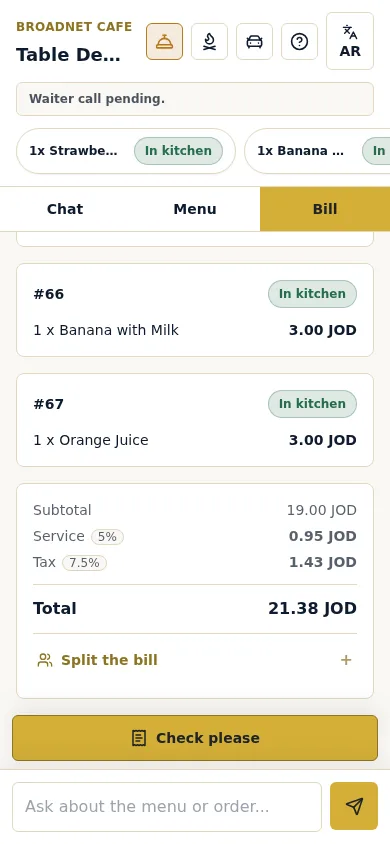
- The check from the table. Guests call a waiter or ask for the check from their phone. It appears on the floor screen within seconds, with cash or card, so the waiter brings the card machine.
- A live bill. The bill updates all evening, including tax and any service charge or gratuity you set, and guests can split it evenly or see just their own share. See waiter call and bill.
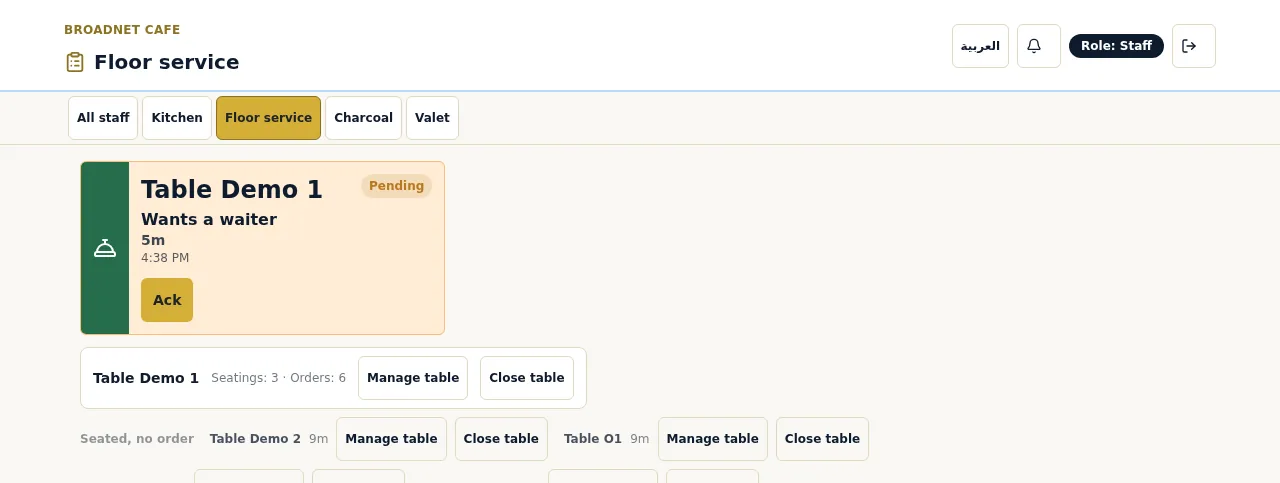
- Waits you can see. Waiting orders and calls change colour at 1, 5 and 10 minutes. The owner’s analytics show how long staff take to confirm orders and answer calls.
What it doesn’t do:
- Take payment. Payment happens with your staff, on the terminal you already use. If the card machine is your longest wait, a pay-at-table tool targets it directly. sunday says “12min saved per table” and Qlub says “Save 16 min Per Table” (vendor claims with no published method, as published on 15 Oct 2026, sunday, Qlub). We can’t verify either, but they aim at a step we leave to you.
- Cook faster. The kitchen’s minutes are the kitchen’s.
- Connect to your POS. There’s no POS or printer connection, so staff enter the sale in the till by hand. See how it works for the full flow.
How do you measure your own turns before you change anything?
Short answer: time ten tables on four normal Fridays, and write down each wait. Here’s a checklist.
- Pick your busiest normal service. Four weeks of the same night. Skip holidays and local events.
- Pull check open and close times from the POS. Average them per party. That’s your average table time.
- Time ten tables by hand. Note four moments: menus closed (ready to order), order taken, check asked for, check paid.
- Time the reset. From the last guest standing up to the next party seated.
- Record the waitlist. Parties waiting at your peak, and parties who left without being seated.
- Calculate the waiting budget. Add the minutes from steps 3 and 4 that nobody chose.
- Decide what success means first, for example “two more parties seated on Friday between 7 and 9 pm”.
- Change one thing at a time, then measure the same four Fridays again.
If step 5 shows no waitlist, stop here. Your problem is filling tables, not turning them.
What to do next
Start with the measurement above. If the waits to order and to get the check are where your minutes go, try a sample order and watch both from the guest’s side and the staff side. WaiterPilot costs a flat $200 per location per month after 30 days free, with 0% commission. For more on how long guests should wait at each step, read how long should guests wait to order?, and for the payment side, pay at table vs order at table.
Questions readers ask
What is a good table turnover rate?
There is no single good number: a café, a steakhouse and a tasting menu turn at very different speeds. We found no independent benchmark we could verify, so compare each service with the same night in earlier weeks, and watch your waitlist.
How do you calculate table turnover rate?
Divide the parties seated in a service by the number of tables. Twenty tables that seat 40 parties between 6 pm and 9 pm turned 2.0 times. Average table time is the total minutes parties sat divided by the number of parties.
Does QR ordering make guests leave faster?
It can shorten meals by removing waits for a server. The best study found tabletop devices cut meal duration by about 10% in one US chain. It studied tablets, not guests' phones, so treat it as a guide, not a promise.
Can I turn tables faster without seeming pushy?
Yes, if you remove waits rather than speed up eating. Let guests order and ask for the check when they're ready, bring the card machine with the check, and reset tables quickly. Dropping the check unasked or clearing plates while others eat feels like rushing.
Does WaiterPilot take payment at the table?
No. Guests see a live bill, can split it, and ask for the check from their phone, saying cash or card. Payment happens with your staff, on the terminal you already use.
Sources
- Research: tabletop technology improves sales 1% per check, reducing meal duration 10%, Restaurant Technology News (reporting Tan and Netessine, Management Science), 2019-07 (checked 2026-10-15)
- At Your Service on the Table (working paper version), Tan and Netessine, Wharton School, 2017-09-10 (checked 2026-10-15)
- The Influence of Table Top Technology in Full-service Restaurants (Cornell Hospitality Report 16(22)), Susskind and Curry, Cornell Center for Hospitality Research, 2016-10 (checked 2026-10-15)
- sunday home page (vendor claims), sunday, 2026 (checked 2026-10-15)
- qlub home page (vendor claims), Qlub, 2026 (checked 2026-10-15)