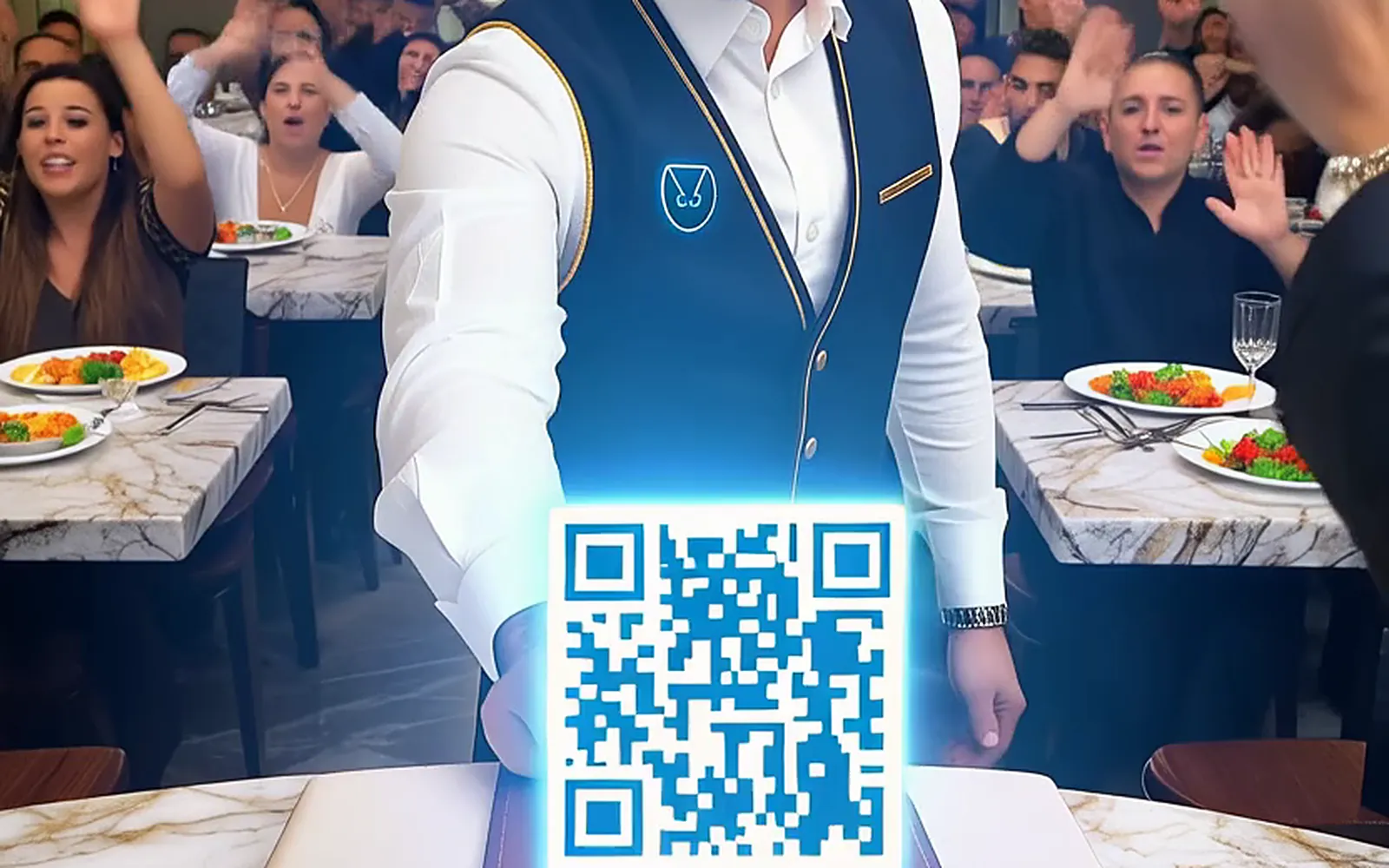
Choosing a system
Tableside ordering: server handhelds or guest QR ordering, and what each costs
Tableside ordering means a server keys the order on a handheld at the table; QR ordering lets guests order on their own phones. Costs, fit and a worked example.

WaiterPilot Research
Updated , 9 min read

The short answer
Tableside ordering means a server takes the order at the table and keys it straight into a handheld device, so it reaches the kitchen without a walk to the till. Guest QR ordering moves the keying to the guest's own phone. Handhelds keep a person taking every order; QR ordering frees that time. You can also mix the two.
Key points
- With handhelds a server still visits the table to take every order; with guest QR ordering the guest keys it and the server visits to serve, help and close.
- As published on 14 Nov 2026, the Square Handheld costs $399 per device, and Square lists tableside ordering on its $49 and $149 restaurant plans, not on the free one.
- We could not read a Toast Go 3 price on Toast's own pages on 14 Nov 2026, so we quote none.
- In our worked example, six Square handhelds plus the Plus plan come to $2,982 in year one; WaiterPilot on the monthly plan comes to $2,200, with no devices to buy.
- If you run Toast or Square and want every order in the POS automatically, handhelds fit better, because WaiterPilot has no POS connection.
On this page
Tableside ordering means a server takes the order at the table and keys it straight into a handheld device, so it reaches the kitchen without a walk back to the till. Guest QR ordering moves the keying to the guest’s own phone: the guest scans a code on the table, orders, and the order goes to staff. The two save different things. Handhelds save the server’s steps; QR ordering saves the server’s visits. A hybrid uses both.
This guide compares the two for a dine-in restaurant, with device prices as published on the pages we opened on 14 Nov 2026 and a worked example for six servers. If you are also weighing kiosks or a tablet on every table, our guide to kiosks, table tablets and guests’ phones covers those.
What is a tableside ordering system?
Short answer: a POS on a device the server carries, so the order is entered at the table instead of at a fixed terminal.
In a classic setup the server writes the order on a pad, walks to a terminal, keys it in, and the ticket prints in the kitchen. A tableside ordering system puts the terminal in the server’s hand. Square describes its “Take orders tableside” feature as a way to “keep servers informed with real-time item and order updates” (Square for Restaurants pricing, read 14 Nov 2026). Square’s page says its handheld can also “accept chip and contactless payments” at the table.
What doesn’t change: a person still walks to the table, asks what everyone wants, answers menu questions and keys every line. The saving is the walk to the terminal and the re-keying, not the conversation.
How is guest QR ordering different?
Short answer: the guest keys the order on their own phone, so the server’s visit is for service, not dictation.
With QR table ordering, guests scan the code on their table and the menu opens in the phone’s browser, with no app to download and no sign-up. With WaiterPilot, guests ask about dishes in their own words and get answers from your menu; when the menu doesn’t say, it tells them to ask a staff member. They call a waiter or ask for the check from the phone, and the request reaches the floor screen within seconds; the check request asks cash or card, so the server brings the card machine.
Staff still decide. The first order at each table waits for a staff member to tap Confirm; after that, new orders from that table go straight to the kitchen until staff close the table. For allergies, WaiterPilot gives what the menu says and asks the guest to confirm with staff, who always have the final word.
The hybrid is the third option. Guests who like their phones order on them; guests who prefer a person tell the server, who keys the order on a device. In WaiterPilot, staff can add a dish for a table from their own screen, so a server with a phone in a pocket can cover both kinds of guest.
How do handhelds and QR ordering compare?
Short answer: they differ most on who keys the order, what you buy and whether orders land in your POS.
Tableside handhelds, guest QR ordering with WaiterPilot, and a hybrid, as published on the pages we read on 14 Nov 2026:
| Server handhelds (POS-based) | Guest QR ordering (WaiterPilot) | Hybrid | |
|---|---|---|---|
| Who keys the order | The server, at the table | The guest, on their own phone | The guest, or the server for guests who ask |
| Devices to buy | One handheld per server on the floor, plus spares and chargers | None: guests use their phones, staff use phones or tablets you already have | Fewer handhelds, or staff phones |
| Link to your POS | Yes: the handheld is part of the POS | None: staff ring orders into the till by hand if you use one | Depends on the tools you mix |
| Taking payment | Usually yes, card at the table | No: guests see a live bill and pay your staff | Usually on the handheld or terminal |
| Languages | The server’s own; menu names as entered in the POS | The chat answers in the guest’s language (tested in English, Arabic dialects and Spanish); buttons in English or Arabic | Both |
| What servers still walk for | Every order, every question, the check, food, clearing | The first-order confirm if needed, food, allergies, payment, clearing, guests who want a person | Somewhere in between |
| Best for | POS-first restaurants that want a person on every order | Busy dining rooms where order-taking, menu questions and checks eat server time | Mixed crowds: regulars, tourists, older guests |
The “what servers still walk for” row is where the time goes. A Cornell report timed servers in one restaurant and found time per table fell from 10 minutes 16 seconds to 3 minutes 30 seconds when guests ordered and paid on a tabletop device (Susskind and Curry, Cornell, 2016, p. 6). It was one restaurant and only 7 tables in that group, so treat it as a hint, not a promise. If you want to turn server minutes into section sizes, see how many tables one server can handle.
How much do restaurant handhelds cost?
Short answer: the Square Handheld is $399 as published on 14 Nov 2026; we could not read a Toast Go 3 price; sunday shows no handheld price.
Here is what we could read on each vendor’s own page on 14 Nov 2026:
- Square. The Square Handheld page says “Make it yours for $399”, or “$37 per month for 12 months” on a credit plan issued by Block at 15% APR (Square Handheld). Square’s restaurant plans are Free at $0, Plus at $49 and Premium at $149 per location a month, and “Take orders tableside” is listed on Plus and Premium, not Free. In-person card rates are 2.6% + 15¢, 2.5% + 15¢ and 2.4% + 15¢ on the three plans (Square pricing).
- Toast. Toast’s hardware and pricing pages returned an error (HTTP 403) to us on 14 Nov 2026, as they did on 15 Oct 2026, so we quote no Toast Go 3 price. Toast’s help page on the Go 3 upgrade for Australia, Canada, Ireland and the UK says that adding devices means you “will need to add an additional monthly handheld software subscription for each new device” (Toast FAQ, updated 9 Apr 2026). So ask for both numbers: the device and the monthly subscription per device.
- sunday. sunday’s pricing page lists “sunday Handhelds” (“Bring the POS to the table”) but shows no device price. Its Standard plan is $199 a month and Premium $299, with QR codes at “$5 / QR code” (sunday pricing).
Device prices are only part of it. Count spares for the device that breaks on a Saturday, chargers or docks, cases, and the card processing that runs through the handheld. Our Toast vs Square comparison goes further on the two POS systems, and what a restaurant POS does explains what the device is part of.
What do handhelds and QR ordering cost for six servers? A worked example
Short answer: in this example, six Square handhelds plus the Plus plan cost $2,982 in year one; WaiterPilot costs $2,200 on the monthly plan, with no devices.
Casa Olivo is a fictional restaurant we use for examples, not a customer.
The assumptions.
- Casa Olivo has 18 tables and 6 servers on the floor at its busiest. It wants one device per server and no spare (most restaurants should add one).
- For handhelds it uses Square: 6 Square Handhelds bought outright at $399 each, and the Plus plan at $49 a month for one location, because tableside ordering is listed on Plus and Premium.
- For QR ordering it uses WaiterPilot on the monthly plan: 30 days free, then $200 a month for the location. Staff use phones and a kitchen tablet the restaurant already owns.
- Card processing is left out of both. Casa Olivo pays its processor either way, and its rates depend on its own deal.
Year one.
| Line | Square handhelds | WaiterPilot |
|---|---|---|
| Devices | 6 × $399 = $2,394 | $0 |
| Software | 12 × $49 = $588 | 11 paid months × $200 = $2,200 (first 30 days free) |
| Year one | $2,982 | $2,200 |
| Each year after | $588, plus replacing worn devices | $2,400 monthly, or $2,000 on the annual plan |
What the table does not show. If Casa Olivo already pays for Square Plus, the extra cost of handhelds in year one is just the $2,394 of devices, and less after that. On that basis handhelds are the cheaper line. What it buys is different, though: with handhelds every order is in the POS and paid on the device, but a server still takes every order. With WaiterPilot no device is bought and guests key their own orders, but staff ring orders into the till by hand and payment stays with the terminal you have.
So compare what you are trying to fix. If the problem is the walk to the terminal, handhelds fix it. If the problem is that servers spend the rush taking orders and explaining dishes, a device in the server’s hand doesn’t change that.
When is WaiterPilot not the right pick?
Short answer: when you want every order in your POS automatically, or payment taken at the table.
WaiterPilot has no POS or kitchen-printer connection. Staff work from its own screens: a main board with every ticket, a kitchen screen with dishes, choices and notes but no prices, and a floor screen for calls and check requests. If you run Toast or Square and want each order to land in the POS and print in the kitchen with no hand entry, handhelds from your POS company fit better. See how WaiterPilot works next to your POS for what the manual step looks like.
WaiterPilot also takes no payments. The bill stays live on every phone at the table, and guests can split it evenly or see their own share, but they pay your staff. If paying at the table is the main problem, a handheld that takes cards is the more direct fix. Our WaiterPilot vs Square comparison sets the two side by side.
And if your guests mostly want a person to take their order, keep that. Handhelds and a good server beat a QR code nobody scans.
Which should you choose?
Short answer: decide by the problem you want to solve, then check the cost.
- Servers lose time walking to the terminal, and orders must be in the POS. Handhelds from your POS company.
- Servers lose time taking orders, explaining dishes or fetching checks. Guest QR ordering.
- Many guests don’t read your menu’s language. Guest QR ordering with a chat that answers in their language.
- Mixed guests, some who want a person. A hybrid: QR for those who like it, a server with a device for those who don’t.
- You can’t spend on devices now. QR ordering on guests’ phones and staff phones you already own.
WaiterPilot costs $200 per location per month after 30 days free, or $2,000 per location per year, with 0% commission, no contract and free setup, including QR cards and staff training. Full details are on the pricing page.
What to do next
Count how many minutes your servers spend taking orders on your busiest hour, then price both options for your own floor using the example above. When you’re ready:
- Start 30 days free, with free setup and QR cards.
- Or book a demo to see the guest and staff screens and ask your questions.
Questions readers ask
What is tableside ordering?
Tableside ordering means a server takes the order at the table and enters it straight into a handheld device, which sends it to the kitchen. It removes the walk to a fixed terminal. The server still visits the table for every order, so it saves steps rather than visits.
How much does a Toast Go 3 cost?
We could not read a price on Toast's own pages on 14 Nov 2026; its hardware and pricing pages returned an error to us. Toast's help page for Australia, Canada, Ireland and the UK says each added handheld needs its own monthly software subscription. Ask Toast for a written quote that covers devices and subscriptions.
How much does a Square handheld cost?
As published on 14 Nov 2026, Square shows the Square Handheld at $399, or $37 a month for 12 months on a credit plan. Square lists tableside ordering on its Plus plan ($49 a month per location) and Premium plan ($149), not on its free plan.
Is QR ordering better than handhelds for a restaurant?
Neither is better everywhere. Handhelds suit restaurants that want a person to take every order and every order in the POS. Guest QR ordering suits restaurants where servers spend too long taking orders, explaining dishes or fetching checks. You can also use both.
Can I use QR ordering and handhelds together?
Yes. Guests order from their phones and servers carry a device to confirm orders, answer calls and add dishes for guests who prefer to tell a person. With WaiterPilot, staff use the board on their own phones and can add a dish for a table themselves.
Do I need to buy handhelds to use WaiterPilot?
No. Guests order on their own phones, and staff use WaiterPilot's screens on phones or tablets you already have. There is no hardware to buy. WaiterPilot also has no POS connection, so if you use a till, staff ring orders into it by hand.
Sources
- Square for Restaurants pricing, Square, 2026 (checked 2026-11-14)
- Square Handheld, Square, 2026 (checked 2026-11-14)
- Toast Go 3 Handheld Upgrade Programme FAQ, Toast, 2026-04-09 (checked 2026-11-14)
- sunday pricing, sunday, 2026 (checked 2026-11-14)
- The Influence of Table Top Technology in Full-service Restaurants (Cornell Hospitality Report 16(22)), Cornell University, Susskind and Curry, 2016-10 (checked 2026-10-15)