Choosing a system
Do customers like QR code menus? What surveys found, 2016 to 2026
About half of sit-down diners say they would order by QR code, and older guests far fewer. What each survey found, who paid for it, and what to do about it.

WaiterPilot Research
Updated , 9 min read

The short answer
Some do, many don't. In the National Restaurant Association's 2024 survey, 59% of full-service diners would open a menu by QR code, 48% would order with one, and only 21% of baby boomers would order that way. Other surveys found a quarter to nearly half of guests uncomfortable with table tech. Offer QR as one way to order, never the only one.
Key points
- In the NRA's 2024 survey, 59% of US full-service diners would view a menu by QR code, 48% would order with one and 46% would pay with one.
- Age is the biggest split: 69% of millennials would order by QR code, against 21% of baby boomers.
- 64% of full-service diners would pick a restaurant with traditional service from employees over one that incorporates technology.
- Comfort with restaurant AI may be rising: a 2026 survey by PAR, which sells restaurant software, found discomfort fell from 41% to 27% in a year.
- The practical answer is to keep servers and the printed menu, make the QR path easy, and give guests a way to reach a person from their phone.
On this page
Some customers like QR code menus, and many don’t. The best recent survey, from the National Restaurant Association in 2024, found that 59% of US full-service diners would open a menu by QR code, 48% would order with one and 46% would pay with one. Age changes the picture completely: 69% of millennials would order by QR code, but only 21% of baby boomers. Other surveys found that between a quarter and almost half of guests don’t like table technology. So the honest answer for an owner is: add QR ordering as one path, and keep the other one open.
This post puts every survey we could verify in one table, with its date, its sample and who paid for it, then turns the numbers into decisions for your dining room.
What did the surveys actually find?
Short answer: about half of sit-down diners are willing to order by QR code, and a stable minority of a quarter to nearly half would rather not use table tech at all.
Here is each survey we could check, oldest first. “Vendor” means the company sells restaurant technology, so read its figures with that in mind.
| Survey | Date | Who was asked | Who paid for it | What it found |
|---|---|---|---|---|
| Cornell Hospitality Report (Susskind and Curry) | Oct 2016 | Guests at a US full-service restaurant chain with tabletop devices | University report; one co-author worked for the tablet maker | “About one-quarter of all guests do not like to use the technology” |
| William Blair, reported by Restaurant Dive | Mar 2023 (published Apr 2023) | US consumers; sample size not stated | Investment bank | 47% not comfortable using QR codes to view menus, order and pay; 65% of those over 60 |
| NRA Restaurant Technology Landscape Report 2024 | 2024 | US adults who ate at a sit-down restaurant in the past 6 months | Trade association | 59% would view a menu by QR code, 48% would order, 46% would pay |
| Same NRA report | 2024 | Same | Trade association | 64% would choose “traditional service from employees” over a restaurant that “incorporates technology” (36%) |
| NRA State of the Industry 2026, reported by Restaurant Dive | Feb 2026 | US adults; sample not stated in the coverage | Trade association | “Roughly six in 10 millennials and Gen Z adults” would place an order with an AI bot |
| PAR Technology, reported by QSR Web and Franchising.com | Jun 2026 | 1,000 US adults, online panel | Vendor (sells restaurant software) | Discomfort with restaurant AI fell “from 41% in 2025 to 27%”; 47% say AI “goes too far” if it replaces most human interaction |
Three things stand out.
- The numbers agree more than the headlines do. “47% uncomfortable” (William Blair) and “48% would order” (NRA) sound like opposite stories. They describe the same split from two sides.
- None of these surveys watched real behavior at your kind of restaurant. They ask what people say they would do. The Cornell report is the only one based on guests who actually had the device in front of them.
- Most are US-only. If your guests are mostly tourists or from another country, these figures are a starting point, not a forecast.
Does age really matter that much?
Short answer: yes. It is the single biggest difference in every survey that reports it.
The NRA’s 2024 report breaks ordering by QR code down by generation, and the same report asked who prefers traditional service:
| Generation | Would order by QR code at a full-service restaurant | Prefer traditional service from employees |
|---|---|---|
| Gen Z | 60% | Not reported in our source |
| Millennials | 69% | 47% |
| Gen X | 52% | Not reported in our source |
| Baby boomers | 21% | 88% |
Source: NRA, Restaurant Technology Landscape Report 2024, pp. 6 and 7.
The William Blair survey points the same way from a different angle: 65% of consumers over 60 were not comfortable using QR codes in restaurants (Restaurant Dive, 2023).
So a neighborhood bistro whose regulars are mostly retirees and a café near a university can read the same survey and reach opposite conclusions. Both would be right.
Do guests prefer tablets or QR codes?
Short answer: in the NRA’s 2024 survey, slightly more guests said they would use a tablet at the table than their own phone via QR code.
The same report asked about both:
| What the guest would do | Tablet at the table | QR code on own phone |
|---|---|---|
| Place an order | 60% | 48% |
| Pay the check | 65% | 46% |
The questions were asked separately, so don’t read the gap as a head-to-head vote. It may reflect what people were used to in 2024 more than a real preference. Tablets also come with hardware the restaurant buys and charges. We compare costs and fit in kiosks, table tablets or guests’ phones.
Are guests warming to AI ordering?
Short answer: possibly, but the evidence comes mostly from a vendor survey, and guests still want a person within reach.
Two recent figures:
- The NRA’s 2026 State of the Industry, as reported by Restaurant Dive, says “roughly six in 10 millennials and Gen Z adults said they would place an order with an AI-generated bot”. The same coverage notes “only 6% of restaurants are using AI for customer orders.”
- PAR Technology, which sells restaurant software, surveyed 1,000 US adults in June 2026. Discomfort with restaurant AI fell “from 41% in 2025 to 27%”. But 47% said AI goes too far “if it replaces most human interaction”, and 44% when “they cannot easily reach a person” (QSR Web and Franchising.com, Aug 2026).
The second finding matters more than the first. Guests don’t object to the screen as such. They object to being left alone with it.
Why do some guests dislike QR menus?
Short answer: the surveys above don’t ask why. What they do show is who dislikes them, and that most guests still want staff available.
Since the “why” isn’t measured, here is a checklist of friction points a QR set-up can create. Test your own set-up against it with a phone and a stopwatch:
- The code opens an app store page or a sign-up form. Every extra step loses some guests.
- The menu is a PDF you have to pinch and zoom. Readable on a laptop, painful on a phone.
- The menu is in a language the guest doesn’t read well.
- There’s no way to ask a question (“is the sauce spicy?”, “what comes with it?”) without waving down a server.
- There’s no visible way to reach a person from the phone.
- The guest has no signal or a flat battery, and nobody offers a printed menu.
- Staff push the QR code instead of offering it.
When you search Google for “i hate qr code menus”, autocomplete finishes the phrase for you (our keyword research, October 2026). That tells you the complaint is common enough to search for. It doesn’t tell you how common.
What does this mean for a real dining room? A Casa Olivo example
Casa Olivo is a fictional restaurant we use for examples. The guest mix below is an assumption, not data.
Say Casa Olivo serves 120 covers on a Friday night. The owner estimates the age mix from regulars and bookings, then applies the NRA’s “would order by QR code” rates to each group:
| Generation | Covers (assumed) | NRA rate: would order by QR code | Covers likely willing |
|---|---|---|---|
| Gen Z | 30 | 60% | 18 |
| Millennials | 40 | 69% | 27.6 |
| Gen X | 30 | 52% | 15.6 |
| Baby boomers | 20 | 21% | 4.2 |
| Total | 120 | about 65 (54%) |
What the owner should take from this:
- About 55 of 120 covers would still rather order with a server. Staffing for “everyone will scan” would leave those guests waiting.
- “Would” is not “will”. People overstate and understate in surveys. Treat 54% as a rough ceiling for the first weeks, then measure.
- Tables, not covers, place orders. One willing person at a table of four can order for everyone, so the share of tables ordering by QR can be higher than the share of willing guests.
- Change the mix and the answer moves fast. With 60 baby boomers and 20 millennials out of 120, the same arithmetic gives well under half.
How do you make QR ordering work for guests who don’t like it?
Short answer: make it optional, make it easy, and keep a person one tap away. Here is a checklist you can use with any vendor, and how WaiterPilot handles each point.
- Keep the printed menu and the server. WaiterPilot runs alongside your printed menu; servers still take orders from anyone who prefers it.
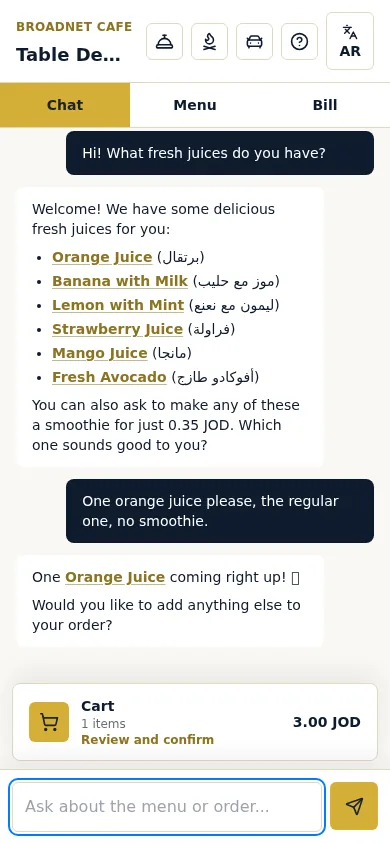
- No app, no sign-up. With WaiterPilot, guests scan the QR code on their table and the menu opens in the phone’s browser. They don’t give a name, phone number or email to order.
- Let guests ask before they order. Guests ask about dishes in their own words, and answers come from your menu. When the menu doesn’t say, WaiterPilot tells the guest to ask a staff member. For allergies, it gives what the menu says and asks the guest to confirm with staff, who always have the final word.
- Answer in the guest’s language. The chat replies in the language the guest writes in. We have tested English, Arabic (several dialects) and Spanish, and it answers most other languages too. The screen buttons are in English or Arabic only. More on multilingual ordering.
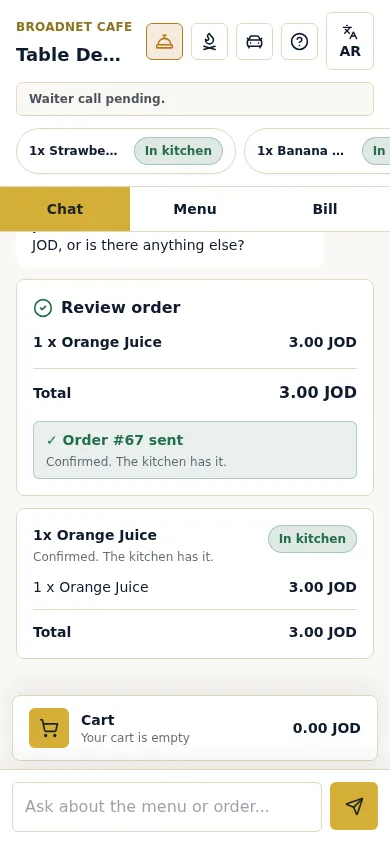
- Put a person one tap away. Guests can call a waiter or ask for the check from their phone, and the request appears on the staff floor screen within seconds. Waiting calls change color at 1, 5 and 10 minutes so nobody is forgotten. See waiter call and bill.
- Let staff check the first order. The first order at each table waits for a staff member to confirm it, so a person sees every table early in the meal.
- Don’t force payment by phone. With WaiterPilot, guests see a live bill and can split it, but they pay your staff the way they do today.
- Train staff to offer, not push. “You can order from your phone, or I’m happy to take it” works better than pointing at the table card.
- Measure your own guests. WaiterPilot’s owner analytics show how many guests scanned, chatted and ordered. That tells you more about your dining room than any national survey.
Where is QR ordering the wrong call?
Short answer: where most of your guests are in the groups that said no.
If your regulars are mostly over 60, if your room is built around tableside service, or if guests come for the conversation with your staff, a QR system may add little. In those rooms, servers with a good printed menu are the better tool, and that includes WaiterPilot’s competitors and WaiterPilot itself. We look at that case in fine dining and AI ordering.
Where QR ordering fits best is the opposite profile: younger guests, busy peaks, many visitors who don’t read the menu’s language, and servers who spend their nights repeating the same explanations. For a broader view of the options, see AI waiter vs QR menu vs POS ordering.
What to do next
Run the Casa Olivo table with your own guest mix. If the willing share is under a third, put your effort into service and your printed menu first. If it’s around half or more, a QR path is worth testing, as long as a person stays one tap away. To see what a guest would see, try a sample order, or read how QR table ordering works with WaiterPilot from scan to served. No hardware is needed to try it: guests use their own phones, and staff use phones or tablets you already have.
Questions readers ask
Do most customers like QR code menus?
About half of US full-service diners say they would use one to order. The NRA's 2024 survey found 59% would open a menu by QR code and 48% would order with one, so a large minority would rather not.
Are older guests less likely to order by QR code?
Yes, by a wide margin. In the NRA's 2024 survey, 21% of baby boomers would order by QR code at a full-service restaurant, against 69% of millennials. In a 2023 William Blair survey, 65% of consumers over 60 were not comfortable using QR codes in restaurants.
Should I get rid of my printed menus if I add QR ordering?
No. Keep printed menus and servers for guests who prefer them. WaiterPilot is designed to run alongside your printed menu, not instead of it.
Are QR menus going away?
The surveys we found don't show that. They show a split: a majority will view a menu by QR code and about half will order with one, while a large share still prefers traditional service. Plan for both groups.
How can I tell whether my own guests like QR ordering?
Count it. Track how many tables scan, how many go on to order, and how many still order with a server. WaiterPilot's owner analytics show a scanned, chatted and ordered funnel for this.
Sources
- Restaurant Technology Landscape Report 2024, National Restaurant Association, 2024 (checked 2026-10-15)
- 47% of consumers uncomfortable using QR codes in restaurants (William Blair survey), Restaurant Dive, 2023-04-19 (checked 2026-10-15)
- The Influence of Table Top Technology in Full-service Restaurants (Cornell Hospitality Report 16(22)), Susskind and Curry, Cornell Center for Hospitality Research, 2016-10-06 (checked 2026-10-15)
- NRA: Restaurant operators are using AI, but not for customer orders (State of the Restaurant Industry 2026 coverage), Restaurant Dive, 2026-02-18 (checked 2026-10-15)
- 3 in 4 diners open to restaurant AI, PAR survey finds, QSR Web (reporting a PAR Technology survey), 2026-08-24 (checked 2026-10-15)
- Diners revise their thoughts about AI, Franchising.com (reporting a PAR Technology survey), 2026-08-31 (checked 2026-10-15)