Explainers
What AI are restaurants actually using in 2026? The survey data
About a quarter of US operators say they use AI tools, but only 6% use AI for customer orders. Each survey here shows its sponsor and when it was collected.

WaiterPilot Research
Updated , 9 min read

The short answer
Less than the headlines suggest, especially for ordering. In the National Restaurant Association's 2026 report, 26% of US operators said they use AI-related tools and only 6% use AI for customer orders. Guests are warming to it: in a June 2026 survey by PAR Technology, which sells restaurant software, discomfort with restaurant AI fell from 41% to 27%, but many still want a person within easy reach.
Key points
- 26% of US operators say they use AI-related tools, and only 6% use AI for customer orders (NRA, reported February 2026).
- Diner discomfort with restaurant AI fell from 41% in 2025 to 27% in June 2026, according to PAR Technology, a restaurant software vendor.
- 47% of diners in the same survey said AI goes too far if it replaces most human interaction, so keep a person easy to reach.
- No peer-reviewed study we could find measures what chat-based AI ordering does to sales; the best evidence is on tabletop tablets from 2012 to 2014.
- Read every AI survey for its sponsor, its fieldwork date, who was asked and the exact question.
On this page
Restaurants use less AI than the headlines suggest, and very little of it takes orders. In the National Restaurant Association’s 2026 report, 26% of US operators said they use AI-related tools, and “only 6% of restaurants are using AI for customer orders” (NRA via Restaurant Dive, 2026). Guests are getting more comfortable with it, but they still want a person they can reach. Below, every survey is shown with who paid for it and when its data was collected, so you can judge each number yourself.
Figures as published on 15 Oct 2026.
Which surveys are behind the numbers, and who ran them?
Short answer: two trade-association surveys, one vendor survey, one investment-bank survey and one peer-reviewed study. Only the last one measures what technology actually did.
| Survey | Who ran it (type) | When the data was collected | Who was asked | AI or tech headline |
|---|---|---|---|---|
| State of the Restaurant Industry 2026 | National Restaurant Association (trade association) | Not stated in the coverage we read; published February 2026 | US operators; sample size not stated in the coverage | 26% use AI-related tools; 6% use AI for customer orders |
| 2026 Industry Report: AI on the Diner’s Terms | PAR Technology (vendor: sells restaurant software) | June 2026 | 1,000 US adults, online, Dynata panel | Discomfort with restaurant AI fell from 41% to 27% |
| 2025 State of the Industry | National Restaurant Association (trade association) | Not stated in the summary; published 6 February 2025 | US operators | 28% plan to invest in technologies “such as Artificial Intelligence” |
| Restaurant Technology Landscape Report 2024 | National Restaurant Association (trade association) | Not stated in the pages we used; published 2024 | US operators, and consumers who ate at a sit-down restaurant in the past six months; online; the methodology note gives no sample size | 16% planned “AI integration (including voice recognition)” for 2024 |
| QR code comfort survey | William Blair (investment bank) | March 2023 wave | US consumers; sample size not stated | 47% not comfortable using QR codes to view menus, order and pay |
| Tan and Netessine, Management Science | Academic, peer reviewed | Transactions from 2012 to 2014 | A 66-restaurant US casual-dining chain, 2.6 million transactions | Tabletop tablets (not AI): about +1% per check, about −10% meal time |
Two cautions apply to the whole table. The NRA 2026 figures come from Restaurant Dive’s report on the study, because the full report costs $349 for non-members. And the PAR figures come from PAR, a company that sells restaurant AI, as reported by trade press. Neither makes the numbers wrong, but you should know where they came from.
How many restaurants actually use AI in 2026?
Short answer: about one in four US operators uses some AI tool, and about one in seventeen uses it to take customer orders.
The 26% figure covers “AI-related tools” of any kind, so it includes scheduling, marketing, inventory and menu-writing software as well as anything guest-facing. The 6% figure is the one that matters if you are thinking about AI ordering: it says AI ordering is still early, and the coverage we read does not say which channels (phone, drive-thru, kiosk or table) the 6% covers.
Here is the direction over three years. The questions differ, so treat it as a trend, not an exact comparison.
| Year | What operators said | Source |
|---|---|---|
| 2024 | 16% planned “AI integration (including voice recognition)” | NRA Restaurant Technology Landscape Report 2024, p. 21 |
| 2025 | “28% of operators plan to invest in technologies, such as Artificial Intelligence” | NRA, 6 Feb 2025 |
| 2026 | 26% use AI-related tools; 6% use AI for customer orders | NRA via Restaurant Dive, 18 Feb 2026 |
The same 2024 NRA report found that 76% of operators say technology gives them a competitive edge, while only 13% think they are on the leading edge. Most restaurants are not early adopters, and that is fine.
What are restaurants using AI for?
Short answer: mostly behind the scenes and at the drive-thru. Taking orders at the table is the smallest slice.
Vendor pages show where AI is being sold. These are the products as each vendor described them on its own page, as published on 15 Oct 2026. They are vendor descriptions, not independent reviews.
| Where AI shows up | Examples, as published on 15 Oct 2026 | What it means for a sit-down restaurant |
|---|---|---|
| Drive-thru voice ordering | Presto’s home page now sells “Presto Voice” for drive-thrus; we found no dine-in table ordering there | Not relevant unless you run a drive-thru |
| Back office and marketing | sunday markets a “sunday AI” suite with AI Menu, AI Tips, AI Reconciliation and AI Online reputation | Helps managers, not the guest at the table |
| Menu building and translation | MENU TIGER lists an AI Menu Builder and multi-language menu translation on every plan, with menus auto-translated “into 30+ foreign languages” | A translated tap-to-order menu; guests can’t ask questions |
| Voice or chat waiters | Butlaroo says its Vivi AI waiter takes orders “by voice or chat - in any language” | Ordering by conversation; Butlaroo lists POS links to “Oracle, Lightspeed, Aloha and more” |
| Chat waiter at the table | Ordder offers an AI Waiter on its Professional and Enterprise plans and says “the guest menu and the AI Waiter speak the same 23 languages”; WaiterPilot is also in this group | Guests ask and order in their own words from their phone |
If you want to know what an AI waiter is, read the AI waiter guide; for how it differs from a robot or a voice bot, see AI waiter vs robot waiter vs voice AI.
Do guests want to order from an AI?
Short answer: more of them than a year ago, as long as a person is still easy to reach.
| Finding | When collected | Who ran it |
|---|---|---|
| Discomfort with restaurant AI fell “from 41% in 2025 to 27%” | June 2026 | PAR Technology (vendor) |
| “62% of respondents would order through a large language model if given the right offer” | June 2026 | PAR Technology (vendor) |
| “47% say AI goes too far if it replaces most human interaction”; 44% when “they cannot easily reach a person” | June 2026 | PAR Technology (vendor) |
| “Roughly six in 10 millennials and Gen Z adults said they would place an order with an AI-generated bot” | Not stated; published February 2026 | National Restaurant Association (trade) |
| 64% of full-service diners would choose “traditional service from employees” over a restaurant that “incorporates technology” (Boomers 88%) | Not stated; published 2024 | National Restaurant Association (trade) |
| 48% would order by QR code at a full-service restaurant (Boomers 21%, Millennials 69%) | Not stated; published 2024 | National Restaurant Association (trade) |
PAR’s figures were reported by QSR Web on 24 Aug 2026 and Franchising.com on 31 Aug 2026.
Put together, the picture is consistent. Younger guests are open to ordering from an AI, older guests much less so, and almost half of all guests draw the line at losing the human. An AI tool that takes the order but makes it hard to reach a server is the version guests say they don’t want.
What does the evidence say AI ordering changes?
Short answer: there is no peer-reviewed study of chat-based AI ordering that we could find. The best evidence is about tabletop tablets, and it points to speed, not bigger checks.
The strongest study of guest-side ordering technology is Tan and Netessine’s, published in Management Science and based on 2.6 million transactions from 2012 to 2014 in a 66-restaurant US chain. Tabletop tablets raised sales per check by about 1% and cut meal duration by about 10% (Restaurant Technology News, 2019). We cover it in detail in does tabletop ordering increase check size?.
Operators seem to expect the same. In the NRA’s 2024 report, 69% said technology “will augment rather than replace human labor”, and 47% expected tech and automation “to help with a current labor shortage” to become more common. For the staffing side of that story, see our dated restaurant labor data page.
AI-waiter vendors do publish bigger numbers: Butlaroo claims a “30% lift in average cover value” and AI-Waiter.com “UP TO +25% AVG CHECK INCREASE” (both as published on 15 Oct 2026). Neither page gives a sample, a period or a comparison group.
How should you read an AI survey before you act on it?
Use this checklist on every number in this post, and on every number a vendor shows you, including us:
- Who paid for it? A trade association, a vendor that sells AI, a bank or a university? Name the sponsor when you repeat the number.
- When was the data collected? A 2023 attitude survey can be out of date by 2026. If the fieldwork date isn’t given, say so.
- Who was asked? Operators or guests? US only? Full-service or all restaurants?
- What exactly was the question? “Use AI-related tools” and “use AI for customer orders” are very different numbers (26% vs 6%).
- Primary or secondary? Did you read the report, or a news story about it? Several figures here are secondary, and we say which.
- Is it a measured effect or an opinion? “Would order through” is an intention. Only the tabletop study above measured what guests actually did.
Where does WaiterPilot fit in this picture?
Short answer: in the small “chat waiter at the table” group, built so that guests can call a person with one tap.
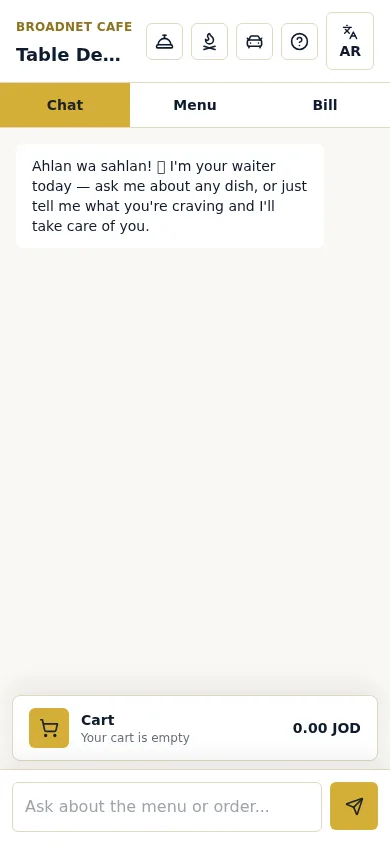
WaiterPilot by BroadNet.AI works like this:
- Guests scan the QR code on their table and the menu opens in their phone’s browser. No app to download, no sign-up.
- They ask about the menu in their own words. Answers come from the restaurant’s menu, and when the menu doesn’t say, WaiterPilot tells the guest to ask a staff member. It stays on the menu and steers off-topic questions back to food.
- The chat answers in the guest’s language. We have tested English, Arabic (several dialects) and Spanish, and it answers most other languages too. The screen buttons are in English or Arabic.
- The first order at each table waits for a staff member to tap Confirm. After that, new orders from the same table go straight to the kitchen until staff close the table.
- Guests can call a waiter or ask for the check from their phone, and it appears on the floor screen within seconds. That is our answer to the 44% who don’t want AI when they can’t easily reach a person.
- For allergies, WaiterPilot gives what the menu says and asks the guest to confirm with staff. Staff always have the final word.
What it doesn’t do: it has no POS or kitchen-printer connection, and it takes no payment. Guests see a live bill and split it, then pay your staff as they do today. It costs $200 per location per month after 30 days free, with 0% commission. More on the product on the AI waiter page.
What to do next
If you’re weighing AI ordering, start with your own floor, not the surveys: where does server time go on a busy night, and how many of your guests struggle with the menu’s language? Then compare the categories honestly in AI waiter vs QR menu vs POS ordering, and try a sample order to see a chat order reach a staff board. It’s a simulation in your browser, with no real order placed.
Questions readers ask
What percentage of restaurants use AI in 2026?
About a quarter of US operators, by the National Restaurant Association's 2026 report: 26% said they use AI-related tools. Only 6% said they use AI for customer orders. The figures come from press coverage of the report, which did not state the sample size.
Do customers want to order from an AI?
More are open to it than a year ago. PAR Technology, a restaurant software vendor, found discomfort with restaurant AI fell from 41% in 2025 to 27% in its June 2026 survey of 1,000 US adults. But 47% said AI goes too far if it replaces most human interaction.
Does AI ordering increase restaurant sales?
We found no peer-reviewed study of chat-based AI ordering and sales. The closest evidence, a study of tabletop tablets in a US chain, found about 1% more per check and about 10% shorter meals. Judge AI ordering on speed and staff time, not on promised bigger checks.
Which AI tools are restaurants using?
Vendor pages checked on 15 Oct 2026 show AI in four places: voice ordering at the drive-thru, back-office tools such as menu writing and reconciliation, menu translation, and chat or voice waiters that take orders at the table.
Why do AI surveys disagree so much?
They ask different people different questions at different times, and many are run by companies that sell AI. Check who sponsored the survey, when it was collected, who was asked and the exact wording before you compare two numbers.
Sources
- National Restaurant Association: operator artificial intelligence adoption (State of the Restaurant Industry 2026), Restaurant Dive, 2026-02-18 (checked 2026-10-15)
- 3 in 4 diners open to restaurant AI, PAR survey finds, QSR Web, 2026-08-24 (checked 2026-10-15)
- Diners revise their thoughts about AI, Franchising.com, 2026-08-31 (checked 2026-10-15)
- Restaurant Technology Landscape Report 2024, National Restaurant Association, 2024 (checked 2026-10-15)
- The 2025 State of the Industry shows cautious optimism, National Restaurant Association, 2025-02-06 (checked 2026-10-15)
- 47% of consumers uncomfortable using QR codes in restaurants (William Blair survey), Restaurant Dive, 2023-04-19 (checked 2026-10-15)
- Research: tabletop technology improves sales 1% per check, reducing meal duration 10%, Restaurant Technology News (reporting Tan and Netessine, Management Science), 2019-07 (checked 2026-10-15)
- Presto home page, Presto, 2026 (checked 2026-10-15)
- sunday home page, sunday, 2026 (checked 2026-10-15)
- Vivi AI waiter, Butlaroo, 2026 (checked 2026-10-15)
- AI-Waiter.com home page, AI WAITER SYSTEMS, 2026 (checked 2026-10-15)
- Ordder AI Waiter, Ordder, 2026 (checked 2026-10-15)
- MENU TIGER pricing, MENU TIGER, 2026 (checked 2026-10-15)