Explainers
Will AI replace waiters? What the job data and diner surveys say
Not on current evidence. US waiter jobs are projected to grow 2% to 2035 and most sit-down diners prefer people. Which tasks AI can take on, and which stay.

WaiterPilot Research
Updated , 8 min read
The short answer
Not on current evidence. US waiter jobs are projected to grow 2% from 2025 to 2035, with about 423,100 openings a year (BLS). Most sit-down diners still want people: 64% chose traditional service over technology in a 2024 survey. AI can take over order-taking and repeat questions; carrying food, allergy calls and hospitality stay with staff.
Key points
- The US had 2,284,400 waiter and waitress jobs in 2025, and the BLS projects 2% growth to 2035 with about 423,100 openings a year.
- In 2024, 64% of full-service diners said they would choose traditional service from employees over a restaurant that uses technology; among boomers it was 88%.
- AI can take the order, answer menu questions from the menu and pass on calls and check requests; it can't carry plates, read a table or take responsibility for an allergy.
- The best evidence on table technology shows faster meals, not fewer servers, and the time-per-table study behind the biggest savings figure covered one restaurant.
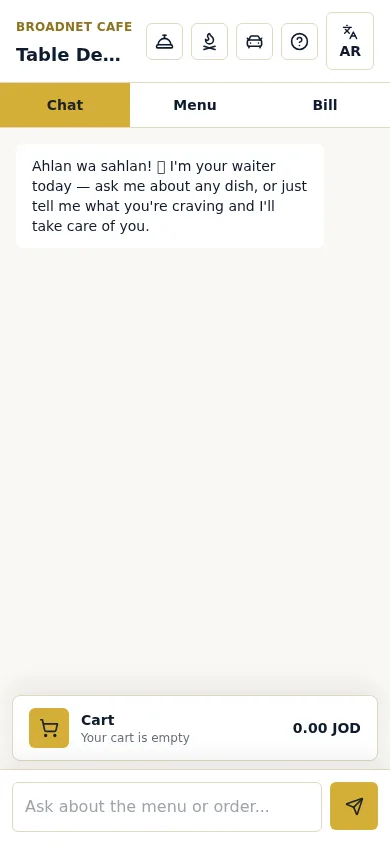
- WaiterPilot is built to take order-taking off servers, not to replace them: staff confirm each table's first order, make and serve the food and have the final say.
On this page
Not on current evidence. US waiter jobs are projected to grow 2% from 2025 to 2035, with about 423,100 openings every year (BLS, 2026), and most sit-down diners say they still want people serving them. What AI is changing is parts of the job: taking the order, answering the same menu questions again and again, and passing on calls and check requests. Carrying food, making the call on an allergy, reading a table and fixing a bad night stay with staff.
We make WaiterPilot, an AI waiter by BroadNet.AI, so we have a stake in this question. Our product is built to take order-taking off servers, not to replace them. That’s why the figures below come from government statistics, trade surveys and academic research, each with its source and date, and why we label vendor figures as such.
What does the job data say about waiters?
Short answer: the job is large, still projected to grow slowly, and hard to keep staffed.
US waiter and server jobs, the latest figures as published by October 2026:
| Measure | Figure | Source |
|---|---|---|
| Waiter and waitress jobs | 2,284,400 (2025) | BLS Occupational Outlook Handbook, 2026 |
| Projected change, 2025 to 2035 | +2% | BLS, 2026 |
| Openings per year, on average | About 423,100 | BLS, 2026 |
| Median wage, tips included | $16.94 an hour, $35,230 a year (May 2025) | BLS, 2026 |
| Monthly quit rate, accommodation and food services | 4.2% (2025), against 2.2% for all private industry | BLS JOLTS, 2026 |
| Waitstaff under 25 | 52% | NRA, Census ACS 2024 data, 2026 |
| Operators without enough staff for demand | About a third | NRA, reported by FE&S, Apr 2026 |
Two things stand out. Growth is slow but positive: the BLS projection is not a forecast of decline. And the openings figure is huge compared with the growth, because most openings replace people who leave. Restaurants don’t have a “too many waiters” problem; they have a “can’t keep waiters” problem. A projection is not a promise, and it will be revised as tools change, but there is no sign in the official data of the job disappearing.
For more on staffing, see our restaurant labor shortage data for 2026.
Do diners want a person or a machine?
Short answer: most sit-down diners still want people, but younger guests are increasingly happy to order from a screen or an AI.
| Finding | Who and when |
|---|---|
| 64% of full-service diners would choose “traditional service from employees” over a restaurant that “incorporates technology” (36%) | NRA Technology Landscape Report, 2024 |
| Boomers: 88% prefer traditional service; millennials: 47% | NRA, 2024 |
| About six in 10 millennial and Gen Z adults would order through an AI bot | NRA State of the Restaurant Industry 2026, reported by Restaurant Dive |
| Discomfort with restaurant AI fell from 41% (2025) to 27% | PAR Technology, which sells restaurant software, 1,000 US adults, June 2026 |
| 47% say AI goes too far if it replaces most human interaction; 44% if they cannot easily reach a person | PAR Technology, June 2026 |
| About a quarter of guests did not like using tabletop technology | Cornell Hospitality Report, 2016 (a co-author worked for the device vendor) |
Read together, these say the same thing: guests accept technology for parts of the meal, as long as a person is within reach. A restaurant that removed its servers would be going against what most of its guests say they want.
Which waiter tasks can AI take, and which can’t it?
Short answer: AI can take the order-taking and the repeat questions; the physical work and the judgment stay with people.
This is the honest split, task by task, with what WaiterPilot does where it applies:
| Task | Can software take it? | Notes |
|---|---|---|
| Taking the order | Yes, for guests who want to | WaiterPilot asks for required choices, and the guest confirms before anything is sent |
| Answering menu questions | Mostly | Answers come from the menu; when the menu doesn’t say, the guest is told to ask staff |
| Speaking the guest’s language | Partly | WaiterPilot’s chat answers in the guest’s language, tested in English, Arabic dialects and Spanish |
| Calling a server over | Yes | A waiter-call button on the guest’s phone |
| Bringing the check | Partly | The guest asks from the phone and chooses cash or card; a person still brings the card machine |
| Splitting the bill | The arithmetic, yes | A live bill split evenly or by each guest’s share; payment is with staff |
| Suggesting something extra | A little | WaiterPilot may ask once whether the guest would like anything with a dish; a server reading the table does this better |
| Allergy decisions | No | WaiterPilot gives what the menu says and asks the guest to confirm with staff, who always have the final word |
| Complaints and problems | No | The AI stays on the menu; problems go to a person through the waiter call |
| Carrying food and drinks | No | Staff make and serve the food |
| Reading the table, pacing, recovering a bad night | No | This is the job guests remember |
The pattern is clear. Software is good at the parts that repeat: writing down the same order, answering the same question about what comes with the burger, walking to the till. People are good at the parts that need judgment and hands. For a practical list of what to move off a server’s plate, see nine jobs you can take off your servers.
What about robot waiters?
Short answer: they are a different product, and we have no independent evidence that they replace servers.
Robot waiters are machines that carry plates from the kitchen to the table. They don’t take orders by conversation, check on guests or handle problems. We haven’t evaluated any, so we make no claims about them. The three kinds of product sold as an “AI waiter” are explained in AI waiter vs robot waiter vs voice AI.
Why do so many people expect AI to replace waiters?
Short answer: because the most visible restaurant AI, at drive-thrus and on phones, does take the whole order, and that gets mixed up with table service.
At a drive-thru, the order is the whole interaction: a voice at a speaker, a payment at the window, food in a bag. When voice AI takes that order, a job really does change. Table service is different. The order is a few minutes of a meal that can last an hour, and most of what a server does happens before and after it. Headlines about robots carrying plates add to the confusion.
Actual use is also smaller than the coverage suggests. In the National Restaurant Association’s 2026 report, only 6% of US restaurants used AI for customer orders, even though about a quarter used some AI-related tool (NRA, reported by Restaurant Dive, 2026). For a map of where AI is used today, see how AI is used in restaurants.
Will restaurants need fewer servers?
Short answer: the evidence shows faster meals and less time per table, not fewer servers, and the biggest time figure comes from one restaurant.
The strongest study is a peer-reviewed analysis of a 66-restaurant US casual chain. Tabletop ordering devices were linked to meals about 10% shorter and about 1% more per check (Tan and Netessine, Management Science, reported by Restaurant Technology News, 2019). Shorter meals mean more tables served in an evening by the same team, not a smaller team.
A Cornell report found server time per table fell 36% when guests paid by device, and 65% when they ordered and paid by device, from 10 minutes 16 seconds to 3 minutes 30 seconds (Cornell Hospitality Report, 2016). That was one restaurant, with 7 tables in the order-and-pay group, and a co-author worked for the device vendor. It is a hint, not a rule.
Operators themselves don’t expect replacement: 69% said technology “will augment rather than replace human labor” (NRA, 2024). We have no data showing WaiterPilot reduces headcount, and we don’t sell it that way.
What does a server’s evening look like with an AI waiter?
Short answer: fewer trips to take orders and fetch checks, and more time at tables that need a person.
Casa Olivo is a fictional restaurant (an example, not a customer). The minutes below are our assumptions, not measurements. Time your own service before relying on any of them.
Assumptions for one server’s section on a Friday: 6 tables, each ordering twice (mains, then dessert or drinks), 3 minutes per order-taking visit, and 2 minutes per check run.
| Task | Without table ordering | With WaiterPilot |
|---|---|---|
| Order-taking visits | 6 tables × 2 orders × 3 min = 36 min | First orders confirmed on the board, assumed 0.5 min each: 6 × 0.5 = 3 min; later orders go straight to the kitchen |
| Check runs | 6 × 2 min = 12 min | Still 6 × 2 min = 12 min: the server brings the card machine or takes cash |
| Total in these two tasks | 48 min | 15 min |
On these assumptions, the server gets back about half an hour in a section, while carrying every plate, answering every waiter call and handling every allergy question in person. Some guests will still want to order from the server, and they should be able to. The table also shows what doesn’t move: the check still needs a person, because WaiterPilot takes no payment.
Are waiters and servers the same?
Short answer: yes. “Server” is the gender-neutral name for the same job.
The US Bureau of Labor Statistics still calls the occupation “waiters and waitresses”. Most restaurants now write “server” on schedules and job ads. In this article we use both to mean the same job.
What should owners and servers do now?
Short answer: owners should move repetitive tasks to tools and keep people on hospitality; servers should lean into the parts software can’t do.
For owners:
- List the tasks your servers repeat most on a busy night.
- Move one of them to a tool, and keep a human path for guests who want it.
- Keep allergy decisions, complaints and payment with staff.
- Measure time to first order and time to check before and after. Don’t expect bigger checks: the peer-reviewed effect is about 1%.
For servers: the valuable skills are the ones in the bottom half of the task table. Knowing the menu deeply, handling allergies with care, reading a table and turning a bad night around are what guests come back for.
What to do next
If your servers spend their evenings writing down orders and walking to the till, see how an AI waiter takes that part over while staff keep the rest. Try a sample order from the guest side, and check pricing: $200 per location per month after 30 days free, with no contract.
Questions readers ask
Will AI replace waiters?
Not on current evidence. The BLS projects US waiter jobs to grow 2% from 2025 to 2035, with about 423,100 openings a year, and 64% of sit-down diners said in 2024 they prefer service from people. AI is taking parts of the job, mainly order-taking, not the whole job.
Will AI replace servers in restaurants?
Unlikely in table service. AI can take orders and answer menu questions, but someone still has to carry food, handle allergies, fix problems and look after guests. In 2024, 69% of operators said technology will augment rather than replace human labor (NRA, 2024).
Are waiters and servers the same?
Yes. "Server" is the gender-neutral name for the same job. The US Bureau of Labor Statistics still calls the occupation "waiters and waitresses", and most restaurants use "server" on schedules and job ads.
Will robots replace waiters?
Robot waiters carry plates across a dining room; they don't take care of guests. We have not found independent data showing they replace servers. They are a different product from an AI waiter, which is software on the guest's phone.
Is being a waiter still a good job in 2026?
It is still a large job market. The BLS counted 2,284,400 waiter jobs in 2025, a median wage of $16.94 an hour including tips (May 2025), and about 423,100 openings a year. Turnover is high: the sector's quit rate is about twice the private-sector average.
Does an AI waiter mean a restaurant needs fewer staff?
Not necessarily. Research on table technology found shorter meals, which can mean more tables served by the same team. We have no data showing WaiterPilot reduces headcount and don't sell it that way. It takes order-taking off servers so they can spend time on guests.
Sources
- Occupational Outlook Handbook: Waiters and Waitresses, US Bureau of Labor Statistics, 2026-08-27 (checked 2026-10-15)
- JOLTS Table 22. Annual average quits rates by industry and region, US Bureau of Labor Statistics, 2026 (checked 2026-10-15)
- Restaurant Employee Demographics, National Restaurant Association, 2026-03 (checked 2026-10-15)
- Restaurant hiring conditions improve, though gaps persist (NRA Research Insight: Workforce Hiring and Staffing), FE&S, 2026-04-28 (checked 2026-10-15)
- Restaurant Technology Landscape Report 2024, National Restaurant Association, 2024 (checked 2026-10-15)
- National Restaurant Association: operator artificial intelligence adoption (State of the Restaurant Industry 2026), Restaurant Dive, 2026-02-18 (checked 2026-10-15)
- 3 in 4 diners open to restaurant AI, PAR survey finds, QSR Web, 2026-08-24 (checked 2026-10-15)
- Diners revise their thoughts about AI, Franchising.com, 2026-08-31 (checked 2026-10-15)
- The Influence of Table Top Technology in Full-service Restaurants (Cornell Hospitality Report 16(22)), Cornell University (Susskind and Curry), 2016-10 (checked 2026-10-15)
- Research: tabletop technology improves sales 1% per check, reducing meal duration 10%, Restaurant Technology News (reporting Tan and Netessine, Management Science), 2019-07 (checked 2026-10-15)