Explainers
How is AI used in restaurants? A 2026 map of uses, job by job
Restaurants use AI for marketing, phones, ordering, menus, payments, kitchens, stock and rotas. A dated map by job, with the proof that exists for each one.

WaiterPilot Editorial
Updated , 8 min read
The short answer
Restaurants use AI for about eight jobs: marketing and reviews, phone calls, drive-thru and table ordering, menu writing and translation, payments, kitchen and stock planning, staff rotas, and owner reports. Adoption is early: in early 2026, 26% of US operators said they used AI tools and only 6% used AI for customer orders. Most proof still comes from vendors.
Key points
- AI in restaurants is not one product: it is a set of tools, each doing one job, from writing marketing copy to taking an order at the table.
- In the National Restaurant Association's 2026 report, 26% of US operators said they use AI-related tools and only 6% use AI for customer orders.
- Almost every performance figure for restaurant AI comes from the company selling it; independent, peer-reviewed evidence is rare.
- Kitchen display screens and kiosks are often sold alongside AI, but most of them are plain software, not AI.
- WaiterPilot covers one cell of the map: ordering by chat at the table, plus reports on what guests asked for.
On this page
Restaurants use AI for about eight jobs, and each is done by a different kind of tool: writing marketing copy and replying to reviews, answering the phone, taking orders at the drive-thru or the table, writing and translating menus, helping with payments and reconciliation, planning stock and prep, building staff rotas, and summarizing the night for the owner. Adoption is still early. In the National Restaurant Association’s 2026 report, 26% of US operators said they use AI-related tools, and only 6% use AI for customer orders (NRA, reported by Restaurant Dive, 2026).
This is a map of those jobs, not a ranking of products. For each one we say what the AI does, who sells it (as published on vendors’ own pages on 15 October 2026), and what proof exists. We make WaiterPilot, an AI waiter by BroadNet.AI, which sits in one cell of the map; we say which one, and what it doesn’t cover. For the survey side of the story, see our companion piece on what AI restaurants are actually using in 2026.
How are restaurants using AI, job by job?
Short answer: in eight jobs, with very different levels of maturity and proof.
The map below shows each job, the kind of tool that does it, example vendors as published on 15 October 2026, and what proof a buyer can check. “Vendor figure” means a number the vendor publishes about itself, which nobody has checked independently. “Not checked” means we did not review vendors in that category for this article.
| Job | What the AI does | Example vendors (as published 15 Oct 2026) | Proof you can check |
|---|---|---|---|
| Marketing, website, reviews | Writes posts and emails, builds the website, drafts review replies | Owner.com (AI-optimized website and marketing, from $249 a month plus 5% per order); sunday (AI online reputation) | Vendor figures only |
| Phone calls | Answers the phone, takes takeaway orders, answers menu questions | Ordder (AI phone waiter on its $199 Enterprise plan); Owner.com (AI Phone Ordering, waitlist) | Vendor figures only |
| Drive-thru ordering | Takes voice orders at the speaker post | Presto (Presto Voice) | Vendor figures only (“Up to 95% Non-intervention rates”, its figure) |
| Ordering at the table | Answers menu questions and takes the order by chat or voice on the guest’s phone | Butlaroo (Vivi), Ordder (AI Waiter, from $79), AI-Waiter.com, WaiterPilot; TabSquare offers “smart recommendations” on a scan-to-open menu | Peer-reviewed research exists for tabletop ordering devices, not for AI chat |
| Menu writing and translation | Drafts menu descriptions; translates the menu | MENU TIGER (AI Menu Builder; menus “into 30+ foreign languages”, its figure); sunday (AI Menu) | Check the output yourself |
| Payments and reconciliation | Matches payments to checks; tip prompts | sunday (AI Tips, AI Reconciliation) | Vendor figures only |
| Kitchen, stock and prep | Forecasts demand and suggests prep or orders | Not checked | Ask for a trial on your own sales data |
| Staff scheduling | Builds rotas from forecast covers | Not checked | Ask for a trial on your own sales data |
| Owner reports | Summarizes the night and spots patterns | Many POS and ordering tools; WaiterPilot reports what guests asked for that isn’t on the menu | Compare against your till |
Two things are often sold next to AI without being AI. A kitchen display screen shows tickets on a screen instead of paper; Square lists its KDS app at $30 a month per device on its Plus plan, and that is screen software, not a model making decisions. A self-order kiosk is a touch screen; Square lists its Kiosk at $99 a month per device. Both can be useful, but don’t pay an “AI” premium for them.
How can AI help restaurants with marketing and reviews?
Short answer: it drafts the words and builds the pages; you still decide what goes out under your name.
This is the most crowded part of the map. Website builders, online-ordering platforms and review tools now write menus, social posts, emails and review replies. Owner.com, for example, sells an AI-optimized website with online ordering, a branded app, loyalty and marketing, at $249 a month plus a 5% restaurant fee per order, or $499 a month flat (as published on 15 October 2026). sunday lists AI online reputation in its AI suite.
What to watch: drafted review replies that promise things you don’t do, and marketing copy with invented facts. Read every draft before it is published. The guest who reads the reply sees your name, not the tool’s.
Can AI answer the restaurant phone?
Short answer: yes. Phone AI picks up, answers questions and takes takeaway orders by voice.
Phone AI is the right kind of tool if missed calls at peak cost you takeaway orders. It needs your menu, call forwarding and a way to get orders to the kitchen. Ordder lists an AI phone waiter on its Enterprise plan; Owner.com lists AI Phone Ordering with a waitlist; me&u lists voice AI among its products without saying which channel it serves. Our guide to whether AI can take restaurant orders compares phone, drive-thru and table AI side by side.
WaiterPilot does not answer phones.
How is AI used to take orders?
Short answer: at drive-thrus by voice, on the phone by voice, and at the table by chat on the guest’s own phone.
Drive-thrus are where voice ordering AI is most visible. Presto, once known for tabletop tablets, now sells drive-thru voice AI.
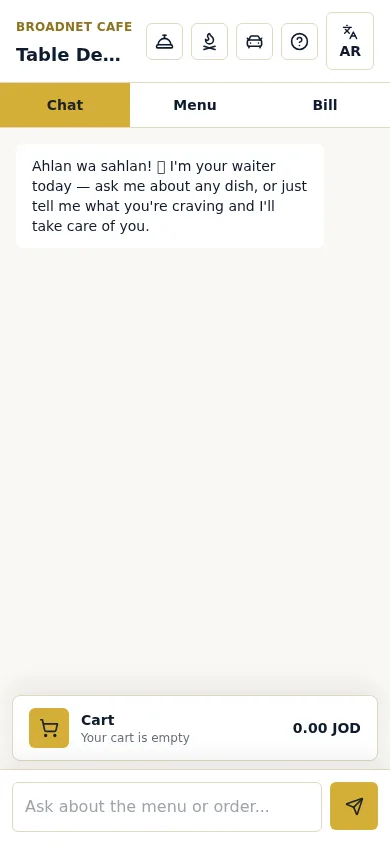
At the table, the guest scans a QR code and orders by talking to the AI, by chat or, with some vendors, by voice. Butlaroo says its Vivi takes orders “by voice or chat”; Ordder’s AI Waiter sits inside its own POS; AI-Waiter.com charges $0.01 per AI request. WaiterPilot is chat only: guests scan the table’s QR code, the menu opens in the phone’s browser with no app, and they ask and order in their own words. Answers come from your menu, and when the menu doesn’t say, the guest is told to ask a staff member.
The best independent evidence on ordering at the table is about tabletop devices, not AI chat. A peer-reviewed study of a 66-restaurant US chain found tabletop ordering devices were linked to about 1% more per check and about 10% shorter meals (Tan and Netessine, Management Science, reported by Restaurant Technology News, 2019). The gain was speed, not bigger checks. No comparable study of AI chat ordering exists yet.
Is AI used in restaurant kitchens?
Short answer: a little, mostly for forecasting and prep; most kitchen screens are not AI.
Vendors pitch AI that forecasts covers and suggests prep lists, and some pitch camera-based monitoring. We did not review any of those vendors for this article, so we name none and quote no figures. If you look at one, ask it to forecast last month from the months before, using your own sales data, and compare its forecast with what really happened.
Kitchen display screens, which replace paper tickets, are usually plain software. WaiterPilot’s kitchen screen is the same kind of thing: it shows dishes, choices and notes, with no prices, on a phone or tablet you already have.
Can AI help with inventory and scheduling?
Short answer: in principle yes, because both start from a forecast; in practice, test it on your own numbers first.
Inventory and scheduling tools take your sales history, predict how busy you’ll be, and suggest what to order and who to roster. The idea is sound. The risk is a forecast that looks precise but misses local events, weather or a new menu. Ask any vendor for a back-test on your own data, ask what it does with a holiday it hasn’t seen before, and keep a person signing off every rota and order.
Restaurants have long expected technology to help with staffing. In 2024, 47% of operators expected tech and automation “to help with a current labor shortage” to become more common, and 69% said technology “will augment rather than replace human labor” (NRA, 2024).
How many restaurants actually use AI in 2026?
Short answer: about a quarter say they use some AI tool, and very few use it to take orders.
| Survey | Who ran it, and when | What it found |
|---|---|---|
| State of the Restaurant Industry 2026 | National Restaurant Association (trade body), reported Feb 2026 | 26% of operators use AI-related tools; 6% use AI for customer orders |
| State of the Industry 2025 | National Restaurant Association, Feb 2025 | 28% of operators planned to invest in technologies such as AI |
| Technology Landscape Report 2024 | National Restaurant Association, 2024 | 16% planned “AI integration (including voice recognition)” |
| AI on the Diner’s Terms, June 2026 | PAR Technology (sells restaurant software), 1,000 US adults | Discomfort with restaurant AI fell from 41% to 27%; 47% say AI goes too far if it replaces most human interaction |
The NRA surveys asked different questions each year, so treat them as a trend, not an exact comparison. More detail, and how to read each survey, is in AI in restaurants in 2026.
What is the best AI for restaurants?
Short answer: the one that fixes your most expensive weekly problem; there is no all-round winner.
Here is a short way to choose:
- Name the job. Which one costs you most: missed calls, slow first orders, a weak website, over-ordering stock, or rotas that don’t match covers?
- Find the tool for that job only. A tool that claims to do all eight jobs probably does a few of them well.
- Ask who measured the result. Most numbers in this market are the vendor’s own figures. Ask for the sample, the period and the comparison group.
- Trial it on your own service. Pick one number before you start, such as calls answered, minutes to first order or waste, and check it after 30 days.
- Keep a person in charge. Allergies, refunds, complaints and anything a guest disputes stay with staff.
Where does WaiterPilot fit on the map?
Short answer: in one cell, ordering at the table, plus owner reports on what guests asked.
WaiterPilot is an AI waiter for dine-in tables. Guests chat in their own language; the chat has been tested in English, Arabic dialects and Spanish, and the guest buttons are in English or Arabic. For allergies it gives what the menu says and asks the guest to confirm with staff, who always have the final word. The owner page shows busy hours, top dishes, what guests asked for that isn’t on the menu and questions it couldn’t answer, and the owner can send a “Tonight at” summary by text or WhatsApp.
It does not do marketing, phones, drive-thrus, payments, stock or rotas, and it doesn’t connect to your POS or kitchen printer. It costs $200 per location per month after 30 days free, with 0% commission and no contract. If table ordering isn’t your most expensive problem, start somewhere else on the map.
What to do next
Pick the one job from the map that costs you most this month and look only at tools for that job. If it’s ordering at the table, compare options in our AI waiter software comparison, read the AI waiter page, and check pricing against what you’d pay elsewhere.
Questions readers ask
How is AI used in restaurants?
Mostly for marketing and reviews, answering phone calls, taking orders at drive-thrus and tables, writing and translating menus, and owner reports. Kitchen, stock and rota tools are growing too. In early 2026 only 6% of US restaurants used AI for customer orders (NRA, 2026).
How can AI help restaurants?
It can take repetitive work off people: answering the same menu questions, picking up calls at peak, drafting replies to reviews, or turning sales history into a prep list. It can't cook, carry plates or make the call on a guest's allergy; staff still do that.
What is the best AI for restaurants?
There isn't one. Each AI tool does one job, so the best one fixes your most expensive problem. Missed takeaway calls need phone AI; slow first orders at the table need table AI; a weak online presence needs marketing tools. Start with one job.
What AI tools do restaurants use?
Common categories are phone-answering AI, drive-thru voice AI, chat ordering at the table (AI waiters), AI menu writers and translators, review and marketing assistants, and forecasting or scheduling tools. In early 2026, 26% of US operators said they use AI-related tools (NRA, 2026).
Are restaurants using AI to take orders?
A few are. The National Restaurant Association's 2026 report found only 6% of US restaurants use AI for customer orders, while about six in 10 millennial and Gen Z adults said they would order through an AI bot. Drive-thrus and phones lead; table ordering is newer.
Is AI worth it for a small restaurant?
Only for a job that costs you money every week. Try one tool on a free trial, measure the one number it should change, and keep it only if that number moves. Be wary of vendor percentages that come without a sample or a comparison group.
Sources
- National Restaurant Association: operator artificial intelligence adoption (State of the Restaurant Industry 2026), Restaurant Dive, 2026-02-18 (checked 2026-10-15)
- The 2025 State of the Industry shows cautious optimism, National Restaurant Association, 2025-02-06 (checked 2026-10-15)
- Restaurant Technology Landscape Report 2024, National Restaurant Association, 2024 (checked 2026-10-15)
- 3 in 4 diners open to restaurant AI, PAR survey finds, QSR Web, 2026-08-24 (checked 2026-10-15)
- Research: tabletop technology improves sales 1% per check, reducing meal duration 10%, Restaurant Technology News (reporting Tan and Netessine, Management Science), 2019-07 (checked 2026-10-15)
- Owner.com pricing, Owner.com, 2026 (checked 2026-10-15)
- sunday home page, sunday, 2026 (checked 2026-10-15)
- me&u home page, me&u, 2026 (checked 2026-10-15)
- Presto home page, Presto, 2026 (checked 2026-10-15)
- Ordder AI Waiter, Ordder, 2026 (checked 2026-10-15)
- AI waiter (Vivi) and FAQ, Butlaroo, 2026 (checked 2026-10-15)
- TabSquare home page, TabSquare, 2026 (checked 2026-10-15)
- MENU TIGER pricing, MENU TIGER, 2026 (checked 2026-10-15)
- Square for Restaurants pricing, Square, 2026 (checked 2026-10-15)