Costs and the numbers
Dine-in ordering vs delivery app commission: why the math is different
Delivery apps charge for finding customers and delivering food. At your own tables neither happens, so a cut of each order is hard to justify. Worked example.

WaiterPilot Research
Updated , 8 min read

The short answer
A delivery app's commission pays for services a dine-in table doesn't use: a marketplace that finds the customer, a courier, and usually payment handling. Guests at your tables already chose you and are served by your staff, so a percentage of every order is harder to justify there. A flat fee stays fixed as you get busier; at very low volume, a small percentage can cost less.
Key points
- Delivery commission and a dine-in ordering fee pay for different services, so they are not like for like.
- At the dine-in table, the guest found you, your staff serve them and you take payment, so there is no marketplace or courier to pay for.
- In our Casa Olivo example, a 1% fee on $112,000 of monthly dine-in orders is $1,120 a month, against a $200 flat fee.
- A flat $200 is cheaper than a 1% fee above $20,000 of monthly sales through the tool, and cheaper than 5% above $4,000.
- Ask every vendor what its percentage is charged on, who pays it, and whether it applies to dine-in orders.
On this page
A delivery app’s commission pays for things a dine-in table doesn’t need: a marketplace that brings the customer to you, a courier who carries the food to them, and usually payment handling in between. When a guest is sitting at your table, they already found you, your staff carry the food, and you take the payment. That’s why a percentage of every dine-in order is hard to justify, and why a flat fee usually makes more sense for ordering at the table.
This isn’t an argument against delivery apps. It’s an argument against paying delivery-style economics for a service that doesn’t deliver anything. Below we compare the two honestly, then work through the numbers for a fictional restaurant with every assumption stated.
Why are dine-in guests your own guests?
Short answer: they came to you. Nobody in the middle found them, carried their food or handled their visit.
Think about how a guest ends up at table 7. They walked past, a friend recommended you, they saw your sign or booked a table. Your host seated them and your server will bring the food. The QR code on the table is a tool they use once they’re already there; it didn’t bring them in.
A delivery order is different. The guest may have found you while scrolling a marketplace and never visited. The app took the order and the payment, a courier carried the bag, and the app handled any complaint. Whatever you think of the rate, the commission pays for real work done by someone other than you.
One clarification: “your own guests” here means the relationship in the room, not a database. WaiterPilot doesn’t collect guest contact details. Guests don’t sign up or give a name, phone number or email to order. The relationship is built the old way, at the table.
What does a delivery commission pay for that a dine-in table doesn’t need?
Short answer: discovery, delivery and, usually, payment. A table ordering tool replaces none of those.
| Service | Delivery marketplace order | Dine-in order at your table |
|---|---|---|
| Finding the customer | The marketplace lists you and shows you to people who may not know you | The guest is already seated |
| Getting the food to the guest | A courier | Your server walks it over |
| Taking the order | The app | The ordering tool, or your server |
| Taking payment | Usually the app | Your till or card terminal (with WaiterPilot, which takes no payment) |
| Handling problems with the order | Often the app first, then you | Your staff, face to face |
| Packaging | Yours, per order | None |
So the services overlap in one row only: taking the order. That’s the part a dine-in tool does, and it’s the part that is cheapest to provide.
We don’t quote delivery-app commission rates in this post. We haven’t verified current published rates, they vary by contract, plan and country, and, as the table shows, they pay for a different service. If you want to compare, use the rate in your own delivery contract and keep in mind what it covers.
Do dine-in ordering tools ever charge a percentage?
Short answer: some do. Most of the published prices we checked are flat or tiered monthly fees.
These are the fee models as each vendor’s own page showed them, as published on 15 Oct 2026:
| Tool | What it is | Fee model as published |
|---|---|---|
| chatQR | AI and voice ordering, sold as a POS and kiosk replacement | “1% of collected customer payments” |
| Ordder | Browser POS with QR ordering | Plans at $29, $79 and $199 a month; its terms say: “Unless stated in writing, Ordder will charge a service fee to clients (not merchants) of 1% on processed transaction volume through Ordder, in addition to payment processor fees.” Ask Ordder how this applies to you |
| Owner.com (online ordering, not table QR) | Website, app and online ordering | $249 a month ”+ 5% restaurant fee per order”, or $499 a month flat; guests also pay a 5% fee |
| MENU TIGER | QR menu and ordering | Free to $119 a month; “No commission per order” |
| sunday | Pay at table plus ordering | $199 or $299 a month; processing fees not stated |
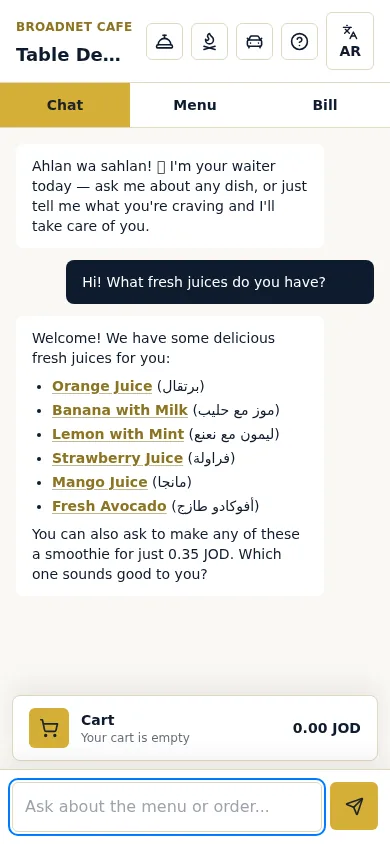
| WaiterPilot | Chat ordering at the table; no payments, no POS link | $200 per location per month or $2,000 per location per year, after 30 days free; 0% commission |
A word on card processing. Any tool that takes payment has processing costs, and those are a cost of payment, not a commission on ordering. WaiterPilot takes no payment, so you keep your current card terminal and your current rates. When you compare tools, compare the total: software fee, any percentage, and processing.
What would a percentage cost at Casa Olivo?
Short answer: in our example, between $700 and $7,700 a month depending on the rate and the month, against $200 flat.
Casa Olivo is a fictional restaurant we use for examples (an example, not a customer). Every number below is an assumption chosen to make the arithmetic clear.
Assumptions
- One location, dine-in only for this comparison.
- A normal month: 4,000 orders through the ordering tool, at an average of $28 per order, so $112,000 of sales through the tool.
- A quiet month: 2,500 orders ($70,000). A busy month: 5,500 orders ($154,000).
- An “order” is one confirmed order sent to staff. A table that orders mains and later dessert counts as two.
- Rates: 1% is the rate chatQR publishes. 5% is the per-order rate in Owner.com’s Flexible plan, which is for online ordering, not table QR. 3% is a hypothetical: if a tool charged 3%. It is not any vendor’s published rate.
- Card processing is left out of every line, because you pay it whichever tool you use.
Monthly cost of the ordering tool
| Month | Sales through the tool | Flat $200 | If a tool charged 1% | If a tool charged 3% (hypothetical) | If a tool charged 5% |
|---|---|---|---|---|---|
| Quiet | $70,000 | $200 | $700 | $2,100 | $3,500 |
| Normal | $112,000 | $200 | $1,120 | $3,360 | $5,600 |
| Busy | $154,000 | $200 | $1,540 | $4,620 | $7,700 |
Per order, in a normal month
| Flat $200 | 1% | 3% (hypothetical) | 5% | |
|---|---|---|---|---|
| Cost per $28 order | $0.05 | $0.28 | $0.84 | $1.40 |
Over a year of normal months
| Flat, monthly plan | Flat, annual plan | 1% | 3% (hypothetical) | 5% |
|---|---|---|---|---|
| $2,400 | $2,000 | $13,440 | $40,320 | $67,200 |
Two things stand out. First, the percentage grows with every busy night, while the flat fee doesn’t move: in Casa Olivo’s busy month the cost per order under the flat fee falls to about $0.04. Second, the gap is big even at 1%. That matters when margins are thin: the National Restaurant Association reported in February 2026 that “42 percent of operators reported their restaurant was not profitable” the year before (NRA, 12 Feb 2026).
When is a percentage the better deal?
Short answer: when very little goes through the tool.
A flat fee is cheaper once monthly sales through the tool times the percentage passes the flat fee. Turned around:
| Percentage | $200 flat is cheaper above this monthly sales through the tool | At Casa Olivo’s $28 average, that is about |
|---|---|---|
| 1% | $20,000 | 715 orders a month |
| 3% (hypothetical) | $6,667 | 239 orders a month |
| 5% | $4,000 | 143 orders a month |
So a small café that sends only a few hundred orders a month through the tool may pay less with a percentage, or with a cheaper tiered plan. A seasonal venue that’s open three months a year may prefer usage pricing too. And if a percentage includes payment processing you’d otherwise pay your card provider, compare the total rather than the headline rate. Our flat fee vs commission guide works this out for three restaurant sizes, including the cases where WaiterPilot is not the cheapest choice.
Should you move guests from delivery to dine-in?
Short answer: that’s a different decision. Keep delivery if it brings orders you wouldn’t otherwise get.
This comparison doesn’t say delivery apps are overpriced. A marketplace that finds you new customers and a courier who carries the food may be worth their price for those orders. The narrower point is that dine-in orders don’t need the same pricing, because none of those services happen at the table.
WaiterPilot is for guests at your tables. It isn’t a delivery marketplace, a courier service or a pickup app, and it won’t change what you pay on delivery orders.
What else should you count besides the fee?
- Staff time. WaiterPilot has no POS or printer connection, so staff ring sales into the till by hand. Count that time; our guide to reconciling QR orders with your till has a worksheet.
- Card processing. Unchanged with WaiterPilot, since you keep your own terminal.
- Hardware. None to buy: guests use their phones and staff use phones or tablets you already have.
- Setup. Free with WaiterPilot, including menu loading, QR cards and staff training.
What to ask any ordering vendor about fees
- Is there a percentage or per-order fee, and on what is it charged: order value, payments processed, or something else?
- Does it include tax and any service charge, or only food and drink?
- Who pays it: the restaurant, the guest, or both?
- Does it apply to dine-in orders, or only to online and delivery orders?
- Is card processing charged separately, and at what rate?
- Is there a minimum term or contract?
- What does a busy month cost compared with a quiet one?
What to do next
Put your own monthly order count and average order into the cost calculator and see where the break-even falls for you. The pricing page has WaiterPilot’s full offer: $200 per location per month or $2,000 per year, 30 days free, no setup fee, 0% commission and no contract. To see what the flat fee buys, try a sample order.
Questions readers ask
Is a dine-in ordering fee the same as a delivery app commission?
No. A delivery app's commission pays for a marketplace, delivery and usually payment handling. A dine-in ordering tool takes orders from guests already sitting at your tables, so the two are different services and their prices aren't directly comparable.
Do any QR ordering tools charge a percentage of dine-in orders?
Some charge a percentage. As published on 15 Oct 2026, chatQR charges 1% of collected customer payments, and Ordder's terms describe a 1% service fee charged to clients on transactions processed through Ordder. Others, including MENU TIGER, sunday and WaiterPilot, publish flat or tiered monthly prices.
When is a percentage fee cheaper than a flat fee?
When your monthly sales through the tool are low. Against a $200 flat fee, a 1% fee costs less below $20,000 a month of sales through the tool, and a 5% fee costs less below $4,000.
Does WaiterPilot charge commission?
No. WaiterPilot charges 0% commission. It costs $200 per location per month, or $2,000 per location per year, after 30 days free, with no setup fee and no contract.
Should I stop using delivery apps?
Not because of this comparison. If a delivery app brings customers and orders you wouldn't otherwise get, its commission may be worth paying. The point is only that dine-in orders don't need delivery-style pricing.
Sources
- chatQR home page, chatQR.ai, 2026 (checked 2026-10-15)
- Owner.com pricing, Owner.com, 2026 (checked 2026-10-15)
- Ordder pricing, Ordder, 2026 (checked 2026-10-15)
- Ordder terms and conditions, Ordder, 2026 (checked 2026-10-15)
- MENU TIGER pricing, MENU TIGER, 2026 (checked 2026-10-15)
- sunday pricing, sunday, 2026 (checked 2026-10-15)
- Persistent cost increases and enduring demand will shape the restaurant industry in 2026, National Restaurant Association, 2026-02-12 (checked 2026-10-15)