Guests in every language
Translated menu or a chat in the guest's language? The options compared
Printed translations, translated QR menus, photos, staff and chat each fail in different places. Cost, upkeep and what happens when a guest asks a question.

WaiterPilot Operations
Updated , 9 min read
The short answer
A translated menu helps guests read; a chat in the guest's language helps them ask. Printed and QR translations are cheap and quick to scan but go stale and can't answer "is this spicy?". A chat answers from your menu in the guest's words but needs a phone, and allergies still go to staff. Most restaurants do best with a printed menu, photos and one of the two.
Key points
- Translations answer "what is this dish?"; only a person or a chat can answer the follow-up question.
- Every menu change has to be made once per language on paper, but only once in total for a chat that answers from your menu.
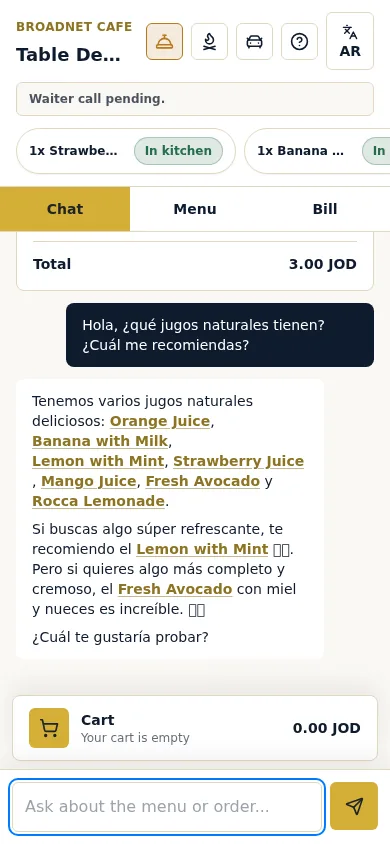
- WaiterPilot's chat replies in the guest's language (tested in English, Arabic and Spanish), while its buttons are English or Arabic and dish names stay as your menu writes them.
- If guests mostly need to read the whole screen in their language, a tool that translates the whole menu fits better.
- Whatever you choose, allergy questions end with a member of staff.
On this page
A translated menu helps guests read your dishes; a chat in the guest’s own language helps them ask about them. Printed translations and translated QR menus are cheap and fast to scan, but they go out of date with every change and can’t answer “is this spicy?” or “what comes with it?”. A chat answers those questions from your menu in the guest’s words, but it needs a phone and a connection, and allergy questions still end with your staff. Most restaurants get the best result from a printed menu, photos, and one of the two.
This guide compares five approaches on cost, upkeep and where each one breaks, then works through one month of menu changes at Casa Olivo to show the upkeep in numbers.
Who needs this?
Short answer: any restaurant where some guests read the menu in their second or third language, and that’s more of them than you’d guess.
UN Tourism estimates 1.52 billion international tourist arrivals in 2025, “almost 60 million more than in 2024” (UN Tourism, 20 Jan 2026). Locals count too. In the US, 22% of people aged 5 and older spoke a language other than English at home, and about 61% of them spoke Spanish (US Census Bureau, 2025). Of the people who spoke another language at home in 2024, 60.9% said they speak English “very well” (USAFacts, from Census data, 2026). The other four in ten are reading your menu more slowly and less surely than you think.
What are the options?
Short answer: five, and they solve different problems. Translations help guests read. Staff and chat help guests ask.
| Approach | What the guest gets | What it costs you | Upkeep | Where it breaks |
|---|---|---|---|---|
| Printed menu in 1–3 extra languages | A menu they can read, no phone needed | A translator per language, plus printing | Every change, in every language, then a reprint | Specials, sold-out dishes, any question not on the page |
| Translated QR menu | The whole menu on their phone in their language | A monthly fee (see the vendor prices below) | Enter changes once; check the machine translation in the languages you can read | Follow-up questions; translation errors nobody on staff can spot |
| Photos of main dishes | “What is it?” answered without words | A photo session | New photo for each new dish | Ingredients, cooking, sides, allergens |
| Staff who speak the language | A real conversation | Hiring for language is hard to plan | None, but they’re not on every shift | The night they’re off; a full room |
| Chat that answers in the guest’s language | Answers to their own questions, in their words | A monthly fee | Enter changes once, in your menu’s language | No phone or signal; your menu says nothing about the question; guests who just want to browse |
None of these is “best”. A guest who wants to browse quietly is better served by a translated menu than by a chat. A guest with three questions about one dish is better served by a person or a chat than by any translation.
What do the tools cost?
Short answer: menu translation tools are cheaper than chat tools, and both cost less than a reprint run in several languages if your menu changes often.
These are vendors’ own published figures, as published on 15 Oct 2026:
| Tool | Type | Languages (vendor claim) | Price (as published on 15 Oct 2026) |
|---|---|---|---|
| MENU TIGER | QR menu with ordering and menu translation | Menus auto-translated “into 30+ foreign languages” | Free plan, then US$17, US$46 and US$119 a month |
| Menutech | Menu writing, translation and QR menu | English, French, German, Italian, Spanish | From “€15,- per month” |
| Ordder | POS with QR ordering and an AI waiter | “The guest menu and the AI Waiter speak the same 23 languages” | AI Waiter on the $79 and $199 monthly plans (pricing) |
| Toast devices | POS | Staff screens in English, Spanish, French or Simplified Chinese; “menu names and items are not translated” (Toast support) | Not published on the pages we could read |
| WaiterPilot | Chat ordering at the table | Chat replies in the guest’s language; buttons English or Arabic | $200 per location per month, 0% commission |
If your main need is a menu guests can read in many languages, MENU TIGER or Menutech will do that for less than we charge. WaiterPilot makes sense when the problem is the questions, not the reading.
Where does each approach break?
Short answer: at the follow-up question, at the menu change, and at the allergy. Here is each approach against five situations a server sees every week.
| Situation | Printed translation | Translated QR menu | Photos | Chat in guest’s language |
|---|---|---|---|---|
| “Is the chorizo spicy?” | Only if the description says so | Only if the description says so | No | Answers from your description; if the menu doesn’t say, tells the guest to ask staff |
| Tonight’s special | Not on the page; server explains | Only if someone added it | Only if photographed | Answers once it’s on your menu |
| A dish sold out at 20:30 | Guest orders it; server goes back to say no | Depends on the tool | Guest still points at it | Once you mark it sold out, it stops offering it |
| “Can I have it without onions?” | Server, in whatever language works | Depends on the tool | No | Goes on the ticket as a note, not translated |
| “I’m allergic to nuts” | Server and kitchen | Server and kitchen | Server and kitchen | Gives what the menu says, asks the guest to confirm with staff |
Two lines in that table matter most.
The note. With WaiterPilot, a special request such as “no onions” goes on the ticket as the request was taken, not translated. So a note can reach your kitchen in Spanish or Japanese. Decide before service who reads those: usually the server who confirms the table’s first order.
The allergy. No translation and no chat should be the last word. WaiterPilot gives what your menu says and asks the guest to confirm with a member of staff; your staff always have the final word. Our allergies and dietary questions page covers the details.
A worked example: one month of menu changes at Casa Olivo
Casa Olivo is a fictional restaurant (an example, not a customer). The numbers below are assumptions chosen to show the arithmetic, not measurements.
Casa Olivo has 48 dishes on an English menu. Its servers hear Spanish, French and Japanese most weeks. In a normal month:
- 4 menu changes: one new special, one price change, two seasonal swaps.
- 6 evenings when a dish sells out mid-service.
Here is the upkeep for that month under three set-ups.
| Task | Printed menu in 3 extra languages | Translated QR menu (3 languages checked) | Chat in the guest’s language |
|---|---|---|---|
| Menu edits | 4 changes × 4 languages = 16 | 4 (entered once) | 4 (entered once) |
| Translations to commission or check | 4 changes × 3 languages = 12 | 4 changes × 3 languages = 12 checks, if anyone on staff reads them | 0 per language, but no one proofreads each reply in advance |
| Reprints | Up to 4 runs | 0 | 0 |
| Sold-out evenings handled by servers at the table | 6 | Depends on the tool | 0: the dish is marked sold out from a phone |
| Questions not covered by the menu | Server | Server | Chat tells the guest to ask staff |
The arithmetic is simple, and it scales badly for paper: each extra printed language adds one more translation per change. With a chat that answers from your menu, a change is made once, in your menu’s language, and the next answer uses it.
The honest catch sits in the second row. With a chat, nobody checks each reply in Japanese before the guest reads it. That is why WaiterPilot answers only from your menu, tells the guest to ask a staff member when the menu doesn’t say, and keeps your staff in charge of allergies. It’s also why we name only the languages we’ve tested: English, Arabic (several dialects) and Spanish. In our 15 Oct 2026 test, a Spanish question was answered in Spanish, with dish names kept as written on the menu.
What doesn’t a multilingual chat fix?
Short answer: anything a guest needs to read without asking, and the parts of the screen that aren’t the chat.
Be exact about the scope before you buy:
| Part of WaiterPilot | Language |
|---|---|
| Chat replies | The language the guest writes in (tested in English, Arabic and Spanish; most other languages also work) |
| Guest screen buttons | English or Arabic |
| Dish names | As written on your menu; saved Arabic names show for Arabic readers |
| Notes on staff tickets | As the request was taken, not translated |
| Allergy decisions | Your staff |
So a Japanese guest sees English buttons and English dish names, and asks in Japanese what they are. If that guest wanted to scroll a fully Japanese menu, a translation tool would serve them better. In the chat, a dish name opens the dish photo, which covers part of the “what is it?” job that photos do on paper.
For Arabic, you can see how much of your menu an Arabic-speaking guest reads in Arabic: the owner’s menu editor shows Arabic coverage for sections, dish names and descriptions, and anything without Arabic text shows in English.
How do you choose? A decision guide
Work down the list and stop at the first line that describes you.
- Most of your non-local guests come in groups on set menus. Print the set menu in the group’s language. Nothing else is worth it.
- Guests mainly need to read and browse, and your menu changes rarely. A printed second language for your top language, plus photos.
- Guests come from many countries, and you want every word on screen in their language. A translated QR menu (MENU TIGER, Menutech or similar). Check the translations in any language someone on staff reads.
- Guests ask a lot of questions, your servers spend the rush explaining dishes, and the menu changes often. A chat that answers in the guest’s language, such as WaiterPilot’s AI waiter, alongside your printed menu.
- You need guests to pay on their phone, or orders to print in the kitchen. Neither translations nor WaiterPilot solves that; see AI waiter vs QR menu vs POS ordering.
Can you combine them?
Yes, and most restaurants should. A good combination for a tourist area:
- The printed menu stays, with your top guest language added or as an insert.
- Photos of the 10 to 15 dishes that sell most.
- Plain ingredient lists under each dish, because they translate better than poetic descriptions and they’re what a chat answers from.
- A chat or translated QR menu for everyone else.
- One rule for allergies in any language: a member of staff at the table.
Our 12-point checklist for serving tourists goes through each of these, and the tourist restaurants page shows how the chat handles a visitor’s question.
What to do next
Write down the five questions your servers answer most often, in the languages they’re asked in. Then try each approach against that list. To test WaiterPilot, try a sample order, or read our multilingual ordering test to see the same question answered in English, Spanish and Gulf Arabic. It costs $200 per location per month after 30 days free, with 0% commission, whatever languages your guests use.
Questions readers ask
Is a translated menu enough for foreign guests?
For reading, often yes. It tells guests what a dish is. It can't answer follow-up questions such as whether a dish is spicy or what comes with it, and it goes out of date every time the menu changes, so pair it with photos and staff who know where to send questions.
Does WaiterPilot translate my menu?
Not as a document. The chat answers questions about your menu in the language the guest writes in, and dish names stay as your menu writes them. The guest screen buttons are in English or Arabic. If you need the whole menu screen in, say, Japanese, a menu translation tool fits better.
Which languages does WaiterPilot's chat handle?
WaiterPilot's chat replies in the language the guest writes in. We have tested English, Arabic (several dialects) and Spanish, and it answers most other languages too. Test the languages your guests use before you rely on them.
Can a translated menu or a chat handle allergies?
Neither should decide. A translated menu can show the allergens you list, and WaiterPilot's chat gives what your menu says and asks the guest to confirm with staff. Staff always have the final word.
Should I stop printing menus if I use a QR menu?
No. Use digital tools alongside your printed menu. Some guests prefer paper, and phones run out of battery.
Sources
- International tourist arrivals up 4% in 2025, reflecting strong travel demand around the world, UN Tourism, 2026-01-20 (checked 2026-10-15)
- 2017-2021 ACS language use tables (press release), US Census Bureau, 2025-06-03 (checked 2026-10-15)
- How many people speak a language other than English at home?, USAFacts (from Census ACS data), 2026-08-13 (checked 2026-10-15)
- MENU TIGER pricing, MENU TIGER, 2026 (checked 2026-10-15)
- Ordder AI Waiter, Ordder, 2026 (checked 2026-10-15)
- Ordder pricing, Ordder, 2026 (checked 2026-10-15)
- Menutech home page, Menutech, 2026 (checked 2026-10-15)
- Update the Language Setting on Your Toast Device, Toast, 2026-10-14 (checked 2026-10-15)